
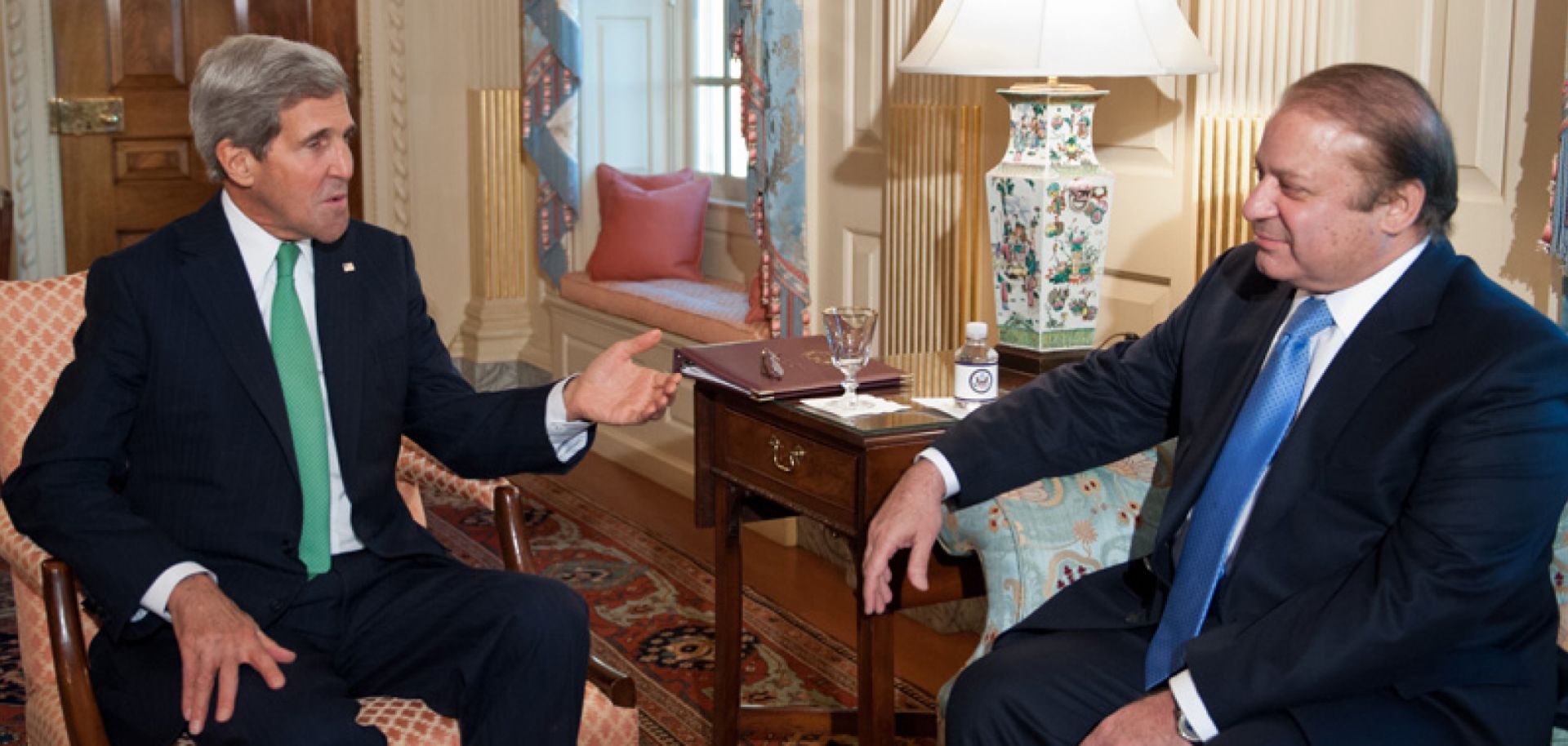
The United States is set to release $1.6 billion worth of security and economic aid to Pakistan after two years of frozen bilateral relations. The decision came as Pakistani Prime Minister Nawaz Sharif met with U.S. Secretary of State John Kerry Oct. 20 and ahead of a scheduled meeting with U.S. President Barack Obama. The resumption of aid is an important political marker for the relationship, but perhaps more importantly, it underlines the extreme economic instability facing Pakistan — instability that U.S. aid alone is insufficient to resolve.
Pakistan is facing a balance of payments challenge resulting from lackluster economic performance. Over the past 10 years exports have doubled, but imports quadrupled, contributing to a goods trade deficit that totaled about $20 billion in 2012, or about 9 percent of GDP. The deficit has been driven by rising demand for increasingly expensive energy resources and food imports. Combined with a growing trade deficit, the security situation has also stunted investment interest, and the country is facing widespread infrastructure deterioration. Pakistan was growing as fast as 8 percent in 2005, but growth has stagnated since the international financial crisis and the IMF expects only 2.3 percent growth in 2013. Meanwhile, Central Bank reserves fell to just $6 billion at the end of June, and the currency has been sliding steeply against the dollar since then.
Pakistan's textile industry sits at the center of these challenges. Pakistan is one of the largest textile exporters in the world, but despite a falling currency that should help to boost the country's competitiveness, progress has been crippled by energy shortages. Blackouts frequently last as long as a day, and factories that rely on natural gas to power looms have struggled amid fuel shortages and rising costs.
Addressing the energy crisis is a core goal of the new Sharif government. There are, however, no immediate solutions. Additional sources of natural gas will be difficult to secure, as Pakistan's infrastructure will make LNG imports difficult. A proposed pipeline from Iran will face political, economic and security impediments. In order to make progress toward his campaign promises, Sharif's only option appears to be an incremental approach to diversifying the country's energy sources. For this, Pakistan has turned to the U.S. and other investors to secure financing for hydroelectric, coal and renewable energy projects. But priority projects like the proposed Diamer-Basha dam that would make a serious dent in the country's energy scarcity would take 10 years and tens of billions of dollars to complete, and are simply not a short-term solution.
The U.S. is not alone in aiding Pakistan. The World Bank promised $5.5 billion in 2011 for two years' worth of development funding and agreed again in August to provide $1.5 billion to support the economic policies of the Sharif government. In September, the IMF agreed to lend Pakistan $6.6 billion to directly address the state's balance of payments challenge. The Sharif government also has a close relationship with the Saudi government, and there has been talk of financial assistance from the kingdom.
Pakistan's strategic location and endemic volatility have helped the country to secure significant external aid, but these loans are ultimately only capable of bridging Pakistan between one crisis and the next. A real reversal of Pakistan's fortunes will come from major improvements of energy infrastructure and movement up the manufacturing value chain that will allow job generation to keep up with population growth. Those kinds of structural adjustments will take years, if not decades, to complete.
