
Maintaining food security is important to social stability in China, but given Beijing's efforts to increase urbanization, complete food self-sufficiency remains unlikely. The Organization for Economic Co-operation and Development and the U.N. Food and Agriculture Organization on June 6 released the highlights of their global agriculture forecast, which included predictions of China's future agricultural production and consumption patterns through 2022. The forecast indicates that the country will remain essentially self-sufficient in rice and wheat but will continue to be dependent on imports of soybeans to meet demand. Imports of corn, which were less than 3 percent of total consumption in 2012, are also projected to increase. The forecast predicts that total consumption will outpace production through 2022.
China has seen an increase in its middle-class population and rapid urbanization. Both trends have contributed to an increase in consumption of meat and dairy, which in turn has caused an increased demand for animal feed, which is usually corn and soy based. The shift toward higher meat and dairy consumption will likely continue considering Beijing's focus on closing the income gap between rural and urban areas in both coastal and inland provinces and its attempts to invigorate the economy through urbanization and industrialization.
According to the forecast, soybean imports, which have already increased from 10 million metric tons in 2000 to roughly 59 million metric tons in 2012, are expected to increase by 40 percent by 2022. Corn imports, which began increasing in 2009, are also expected to climb steadily over the next decade. This is in part due to dietary changes resulting from urbanization and increases in income. The increase in imports runs counter to China's goal of self-sufficiency (achieved by meeting 95 percent of consumption requirements for corn, wheat and rice domestically) in agriculture. An adjustment in the self-sustainability policy will likely be necessary given the central strategy of closing the rural-urban divide.
Changes in Chinese Agricultural Policy
Since 1978 there have been a series of reforms to the control of Chinese agricultural production as well as efforts to promote greater output.
- Beginning in 1949, Chinese grain was collected and distributed by the state-run Unified Purchase and Sales System, but there was little incentive to produce extra grain, leading to declining production.
- Agricultural reforms began in 1978, including the Family Production Responsibility System, which successfully used incentives to encourage increased production, and the sale of grain on local markets was permitted once state quotas were met.
- Further reforms through the 1980s and early 1990s allowed for the establishment of the current state reserve system in response to surpluses.
- The next set of reforms, in 1995, established the Governors' Grain-Bag Responsibility System, which gave each province control over and responsibility for maintaining its grain quotas and supply and demand balance.
- In the late 1990s, the central government reestablished control over the grain sector.
- In 2001, China joined the World Trade Organization, opening all markets, including grain.
Alongside direct policy reforms, the increased use of irrigation and technological improvements enabled Chinese agricultural production to increase substantially over the past 35 years (an increase in output of cereals, coarse grain and oilseeds of 285 million metric tons, from 305 million metric tons in 1978 to 590 million metric tons in 2012). Food security has greatly improved throughout the country, and grain shortages are no longer the threat that they once were. According to the Food and Agriculture Organization, 21 percent of China's population was undernourished in 1990; by 2012, that figure was down to 12 percent.
Although the use of irrigation and other technologies has been encouraged, often through subsidization, to increase yields and to promote self-sufficiency, agriculture in China has remained relatively labor intensive. Mechanized farming has been implemented more heavily over the past decade to help production meet rising demand, even as cultivated acreage decreased from approximately 130 million hectares (320 million acres) in 1997 to 121.7 million hectares in 2008. Limited land and water resources will continue to be a problem for Chinese agricultural production in the future.
Production and Consumption Patterns
Consumption patterns of the two Chinese staples, rice and wheat, have traditionally been regionalized. Rice consumption dominates the south, and wheat is more prevalent in the north. Production patterns are similarly regionalized; rice and wheat have traditionally been produced in central and northern China, respectively. Soybeans and corn are primarily grown in the northeast plain, and large-scale protein production, specifically pig farms, has also emerged in northern and northeastern China to be in proximity to the production of corn feed.
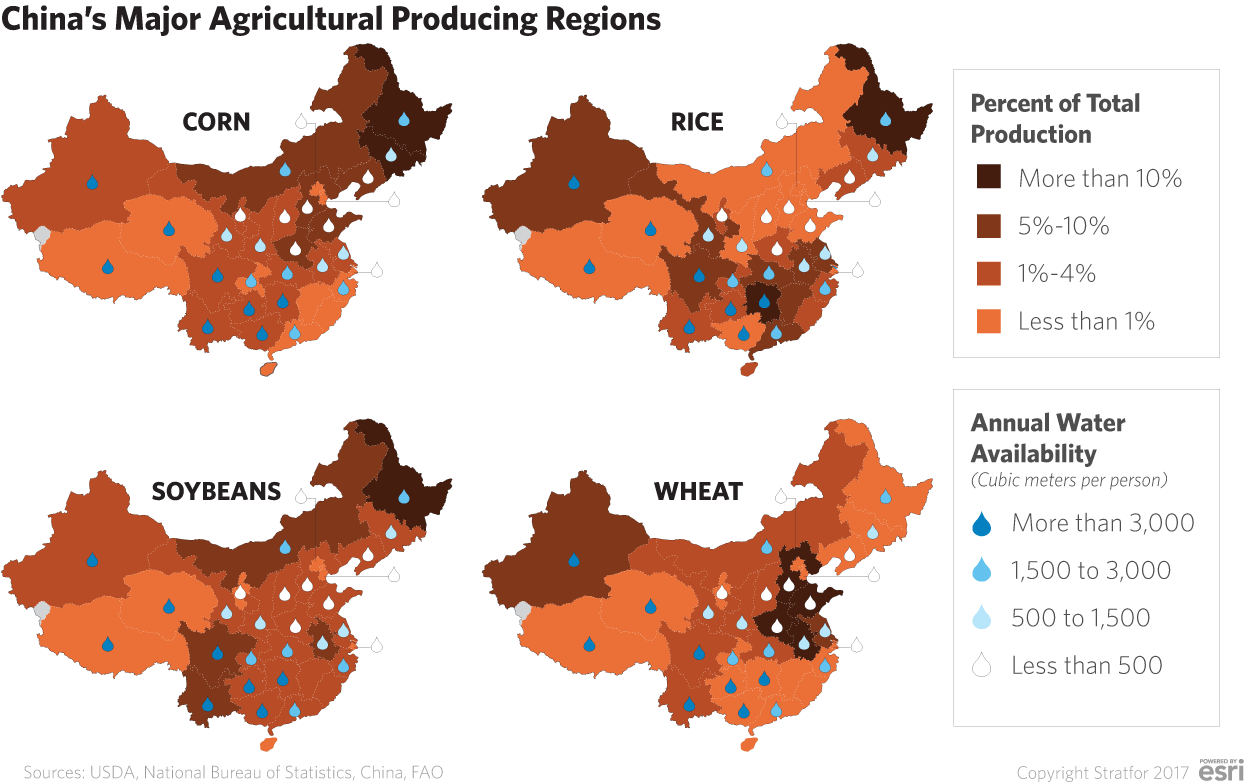
This is indicative of a strategic push underway in Beijing to take advantage of available arable land in less-populated areas to replace the traditional farming land lost to urbanization. For example, Heilongjiang, a sparsely populated province in the extreme northeast of China that has not historically been a grain producer, was responsible for 11 percent of China's rice output in 2010. (It also was the country's largest producer of corn and produced half its soybeans in the same year.) This new agricultural area in the northeast is far from the demand centers in central and southern China and illustrates a potential ongoing shift toward the centralization of grain markets.
China has worked to achieve self-sufficiency in wheat, rice and corn — though not soybeans — and has been relatively successful. (It has been harder for domestic soybean producers to remain competitive with imports, and roughly 80 percent of all Chinese soybean consumption comes from imports.) Self-sufficiency in wheat, rice and corn would still help protect Beijing from fluctuations in global supply and prices, in turn helping to mitigate any associated unrest.
However, there are other policies — namely, the push for urbanization and industrialization — that threaten the goal of self-sufficiency, particularly when it comes to corn. As rural incomes increase, consumption patterns change. Protein consumption has already increased by more than 30 percent between 1990 and 2005. The increased size of the middle class will likely continue this trend and will increase demand for corn and soybeans at a more rapid rate than for wheat and rice.
Land and water are limited resources in China. The country possesses less than 10 percent of the globe's arable land and available freshwater but 20 percent of its population. It is the increasing demand for corn in particular that will threaten China's goal of grain self-sufficiency. The Organization for Economic Co-operation and Development and Food and Agriculture Organization forecast predicts that coarse grain production (which is primarily corn) will increase by 28 percent by 2022 but that consumption will increase by 35 percent. These numbers are fairly close given the time frame of the forecast, but the potential for increased imports remains.
Continued subsidization and promotion of mechanization, irrigation and other technologies will help increase yields. There may also be a further shift toward a more centralized grain market as larger farms in the northeast help meet demand deficits in other parts of the country as urbanization continues. However, demand is projected to only increase, and predicted import levels are already near import quotas. It is possible that Beijing will exert additional controls over the sector to prevent an increase in import levels, but it will somehow have to offset the increasing demand of the growing middle class. Such demand could eventually force China to sacrifice a level of self-sufficiency.
