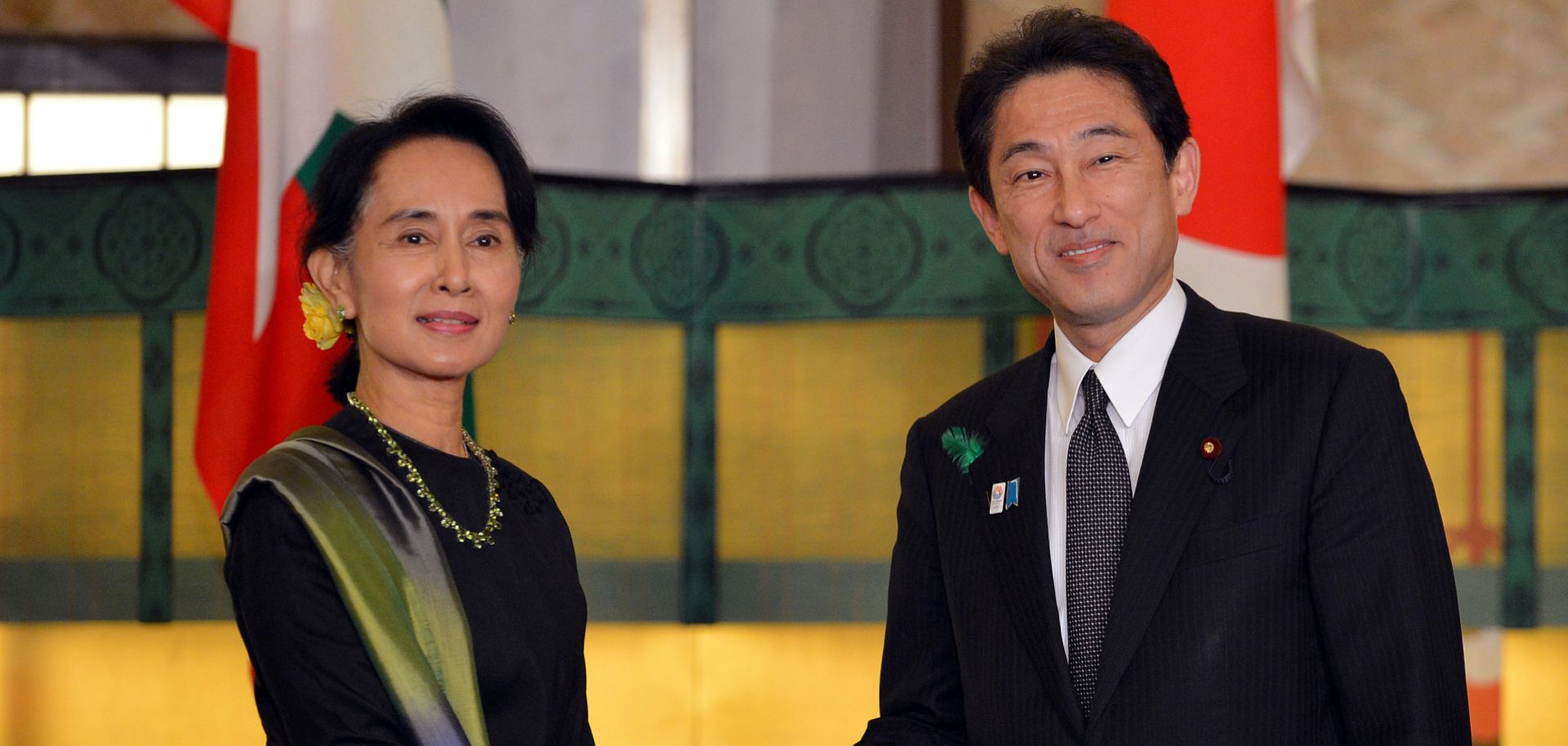
Myanmar's democracy leader Aung San Suu Kyi (L) shakes hands with Japanese Foreign Minister Fumio Kishida prior to their talks at the Iikura guesthouse in Tokyo on April 16, 2013.
Since Myanmar President Thein Sein took office in March 2011 following decades of international isolation, the country has embarked on an economic and political liberalization campaign. Myanmar's strategic location in Southeast Asia and its supply of cheap labor have helped the country become an attractive area for foreign investment by larger, competing powers in the region. Japan, in particular, sees Myanmar's needs and its own as complementary. As part of its push into Myanmar, Tokyo may increase cooperation with India, another country looking to expand its presence in its eastern neighbor.
Myanmar occupies an important position on the Indochinese Peninsula, linking India, China, Bangladesh, Thailand and Laos, another inland corridor country. Historically, Myanmar's strategic location has subjected the country to attempted conquests by several foreign powers. The United Kingdom fought several wars in the country during the 19th century, culminating with Myanmar's annexation into the British Empire in 1886.
British rule ended when Japan occupied Myanmar during World War II as part of Tokyo's own colonial expansion. Japanese control ended with its defeat in World War II, after which Myanmar devolved into a civil war that eventually led to a takeover by a military junta in 1962. Still, Tokyo retained a significant economic presence in Myanmar until the 1980s, when international pressure forced it and other countries such as India and Thailand to vastly reduce their economic and political ties with the country. Since then, China has been Myanmar's primary patron.
Myanmar's Assets
Myanmar's recent opening and ongoing transition out of international isolation have created opportunities for its former partners to reestablish ties and for Naypyidaw to capitalize on its location and attract more foreign investment and development. With a population of 60 million and low labor costs, port access at Yangon and expanding overland transport routes, Myanmar and the broader region offer foreign investors opportunities to develop a continental manufacturing base near key consumer markets and access to waters connected to broader Asia-Pacific economies.
The effort to revitalize relations with Myanmar will likely face opposition from China. Beginning in the 1980s, when traditional partners such as Japan and India withdrew from Myanmar (though Japan remained engaged in a limited way through foreign aid), Beijing took advantage of the country's political isolation to develop political and economic relationships with the ruling military elite. Now, with Naypyidaw opening to the West, Myanmar is poised to use its strategic location and huge investment potential to diversify its relationships beyond China. Indeed, Stratfor has received indications that Myanmar's relationship with Beijing may be cooling. Sensing an opportunity, Japan has boosted its humanitarian aid in recent years, helping facilitate Tokyo's reentry into the region.
Despite its location in Asia's northeast, Japan was the most powerful actor in Southeast Asia in the period before the Myanmar junta's takeover in the 1960s. The importance of the region has expanded as maritime tensions in both the South China Sea and East China Sea have grown along with China's military rise. Recently, Japanese corporations have been increasingly moving manufacturing operations into Southeast Asia to augment logistics chains for operations in Thailand.
Moreover, following the 2011 floods in Thailand that shut down many manufacturing operations, companies have begun putting more emphasis on logistical resiliency and redundancy. In addition to cheap labor, foreign corporations are also looking for guarantees of sustained production. There is growing anecdotal evidence that Japan is seriously considering moving some of its overseas manufacturing from China to Thailand, with an eye toward transferring operations into broader Southeast Asia.
Revitalizing Tokyo's Influence
Historically, Tokyo has been close to Myanmar, despite Japan's occupation during World War II. The type of regime ruling in Myanmar has, for the most part, mattered little to Japan — as demonstrated by Tokyo's immediate recognition of the most recent military-led government formed in 1988. Japan remained a key foreign player in Myanmar until it was largely forced out of the country by a souring relationship with the junta and the country's subsequent international isolation. Despite the two countries' less-than-warm political relations in recent decades, Japan needs Myanmar in order to pursue its broader goal of reestablishing influence in Southeast Asia.
Myanmar was at the western edge of Japan's wartime strategy known as the Greater East Asia Co-Prosperity Sphere. That strategy was enforced at gunpoint in occupied countries, which often violently opposed the Japanese presence. The increasingly nationalistic domestic political environment in Japan indicates that the country has not given up hope of regaining its historical sphere of influence, in part by entering Myanmar.
One of the most notable features of Japan's increasing engagement with Myanmar is the influence of the so-called Myanmar lobbies, many of which are headed by influential figures involved in imperial Japan's war in Southeast Asia. For example, the Nippon Foundation — which was founded by former war crimes suspect, businessman and major political power broker Ryoichi Sasakwa — pledged in October to send a $3 million aid package to help improve the lives of Myanmar's ethnic minorities. As part of that initiative, the foundation hosted the heads of Myanmar's various rebel groups in Tokyo on Oct. 19 for a series of talks about humanitarian aid and the ongoing peace process.
Convergence and Cooperation
Like Japan, India is a country with a largely insular recent history regarding international involvement in the Asia-Pacific region. Both countries also have similarly slow-moving, highly bureaucratic governments that put them at a disadvantage compared to China. Even though New Delhi and Tokyo are traditionally cautious regarding their choices of strategic partners, the current regional dynamics point to the possibility of greater Indian and Japanese cooperation.
India was Myanmar's largest trade partner before the military junta assumed power in 1962, though most of the trade was based on rice exports. Although exports have risen in recent years, India has begun to focus on building infrastructure links while also attempting to rebuild political ties lost during Myanmar's isolation. India's recent push for re-engagement is also intended to establish Myanmar as its starting point for future integration and economic expansion throughout the greater Mekong sub-region.
This complements Japan's own goals, since Tokyo's economic interests extend all the way through Myanmar to India's northern plains, where Japanese corporations have also been increasing their manufacturing footprint, financial participation and development assistance. The potential for economic cooperation, plus other shared interests such as China's containment, Iran's oil exports, and technological exchange on nuclear energy, provide numerous opportunities for bilateral partnerships.
For a capital-rich, high-wage and aging country like Japan, Southeast Asia's cheap labor, abundant resources and proximity to export markets such as China make the entire region a strategic asset. India's large consumer market and labor pool, its natural resources and its geographic position are logical counterparts to Japan's technological capabilities and capital. Coupled with mutual concerns regarding Chinese regional expansion, and mutually beneficial goals regarding Myanmar's infrastructural integration, the convergence of Japanese and Indian interests could lead to increased cooperation between the two countries.