
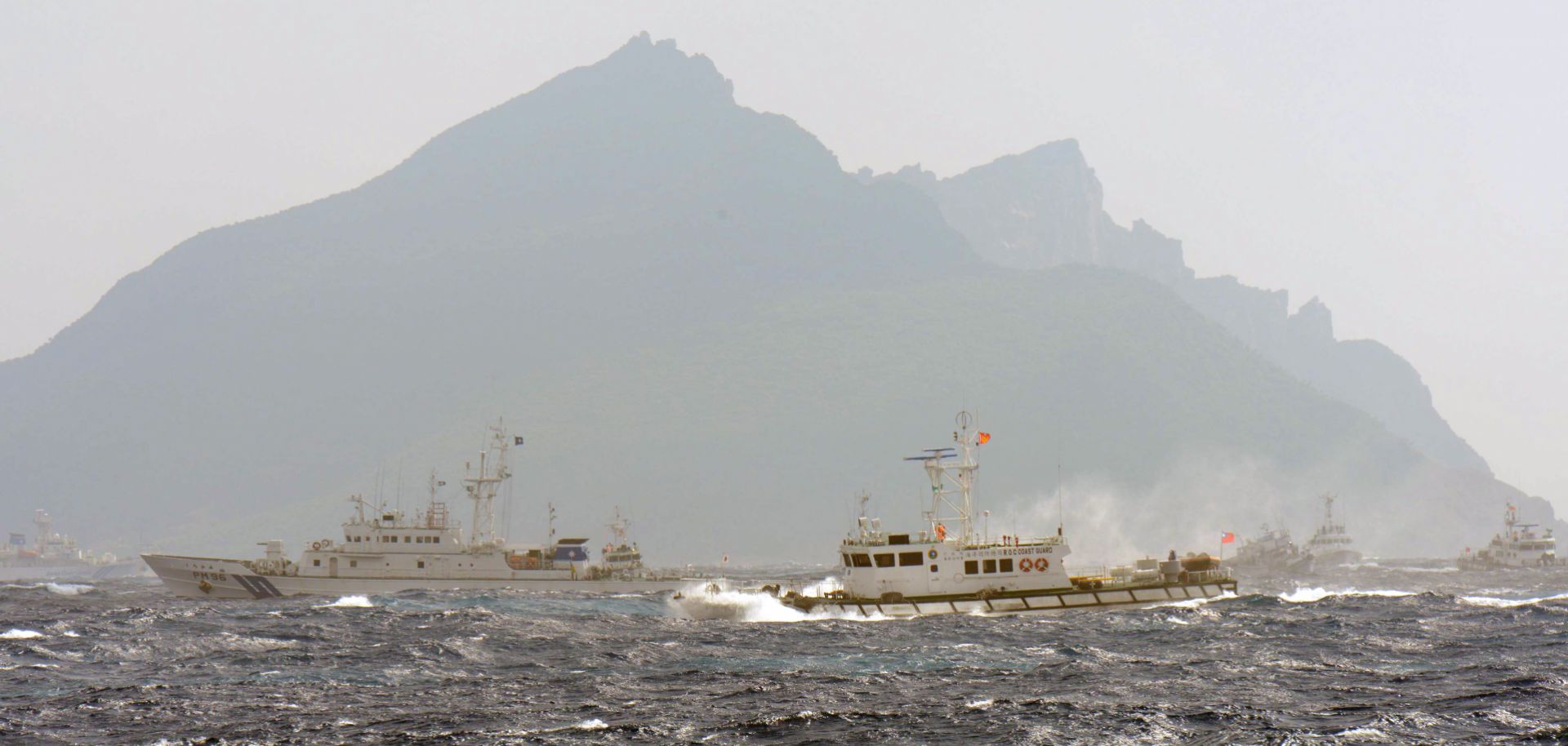
Like China and Japan, Taiwan claims the Diaoyu/Senkaku islands as its own — in Taiwanese, the islets are known as the Diaoyutai Islands. But unlike China and Japan, Taiwan cannot challenge the others' sovereignty claims directly, relegating Taipei to a more limited role in the territorial dispute. However, tensions between Beijing and Tokyo may allow Taipei to become more assertive as it reconfigures its posture toward the islands — so long as that posturing does not challenge the strategic interests of its more powerful neighbors.
In mid-September, the Japanese government proposed resuming talks with Taiwan over fishing rights near the disputed waters, which was followed by a Taiwanese official's statement on Oct. 8 that Taipei also hoped to resume the talks. The offer came despite opposition from the Taiwanese public, which protested Japan's move to nationalize the islands, resulting in some diplomatic tensions between Taipei and Tokyo. After the announcement, Beijing warned that negotiations would be based on the "One China" policy, which maintains that Taiwan and the mainland are one country.

Taipei's Evolving Policy
Despite its claims to the islands, Taiwan has not asserted its sovereignty aggressively in recent decades. Its reticence is understandable; it uses the same rationale as China for claiming the East China Sea, but its actions are constrained by its security dependence on the United States and Japan. Taiwan is also constrained by its size and its proximity to China, as well as by its circumstances. Accordingly, Taipei paid little attention to Diaoyutai sovereignty issues until the 1960s, when natural gas was discovered beneath the East China Sea, which Taipei considers its traditional backwater due to proximity, its historical influence with the Ryukyu Islands and the presence of Taiwanese fishermen.
In the early 1970s, the United States transferred control of the islands to Japan. The move infuriated the Taiwanese, who went so far as to call for militarily guarding the islands. But because Taiwan depended on the United States and Japan for its security, there was little Taipei could do. Taiwan also came to rely diplomatically on the United States and in particular Japan after the international recognition of the People's Republic of China — a development that forms the core of cross-strait relations. The island issue has since become a contentious public issue in Taiwan.
Since the 1990s, Taiwanese presidents have had to balance Japan with cross-strait tensions, so they have largely refrained from provoking Tokyo. Instead, Taiwan has taken a more practical approach, focusing on retaining fisherman's rights while undermining Beijing's territorial claims. Former President Lee Teng-hui even acknowledged Japan's sovereignty of the islands after he retired.
At the outset of his administration, Ma continued these policies. However, the recent tensions in the East China Sea have marginalized Taiwan and reshaped the maritime environment. Between an increasingly militaristic China and the strong Japanese maritime presence, Taiwan can no longer maintain its defensive posture to protect its interests. This explains why Taiwan dispatched 12 coastal patrol ships in late September to escort Taiwanese fishing boats in the disputed waters — the first time Taipei has done so in four years — and Ma's Aug. 14 statement calling for an East China Sea peace initiative. It seems that Taiwan's ambiguous stance on the islands is becoming more assertive.
Political Calculations
Of course, such gestures are largely symbolic and mostly intended to remind others of Taiwan's admittedly small stake in the dispute. While the gestures carry little weight, Japan and China are nonetheless factoring them into their political calculations.
China actually welcomed Taiwan's new policy — in fact, it encouraged Taipei to take a stronger stance. Rather than seeing the move as a threat, China sees it as an opportunity to bolster its claim to the islands through the hope of cross-strait unity and the appearance of multilateralism.
Beijing's strategy is twofold. Were Taiwan to take the lead in the dispute, China would appear less adversarial in the dispute. In addition, giving the appearance of cooperation could generate political capital at home. Otherwise it could cater to pro-unification factions in Taiwan. Seeing Taiwan's reticence as validation of its own claim, Japan is weary of Taiwan's new posture. While cooperation between China and Taiwan is at best a remote concern for Japan, Tokyo does not want another country protesting its territorial claims or enhancing Beijing's bargaining power.
Therefore, Japan is attempting to neutralize Taipei and undermine Beijing's ability to exploit the dispute. Resuming talks over fishing rights is part of this strategy, since it allows Taiwan to enhance its presence near the island while avoiding direct conflict. While Japan already agreed to allow fishermen from other countries to fish the waters, the fear of a Chinese response and little incentive to cooperate with Taiwan has prevented Tokyo from making such a deal with Taipei.
For Taiwan, resuming talks over fishing rights could give the small island nation credibility in its handling of territorial claims, especially among fisherman in northeast Taiwan, a traditional stronghold for the political opposition. The assertive stance also has given the government some political capital amid declining popularity. Moreover, the standoff between China and Japan is giving Taiwan some room to maneuver, allowing it to assert its own claims independent of China.
Although Taipei could benefit from current tensions to enhance its presence in the East China Sea, without leverage Taiwan cannot directly defend its sovereignty claims against China or Japan. It is simply far too economically and militarily beholden to both countries. Taipei can enhance its bargaining position with Japan, but its newfound assertion will be limited in order to avoid challenging the strategic interests of its more powerful neighbors.
