
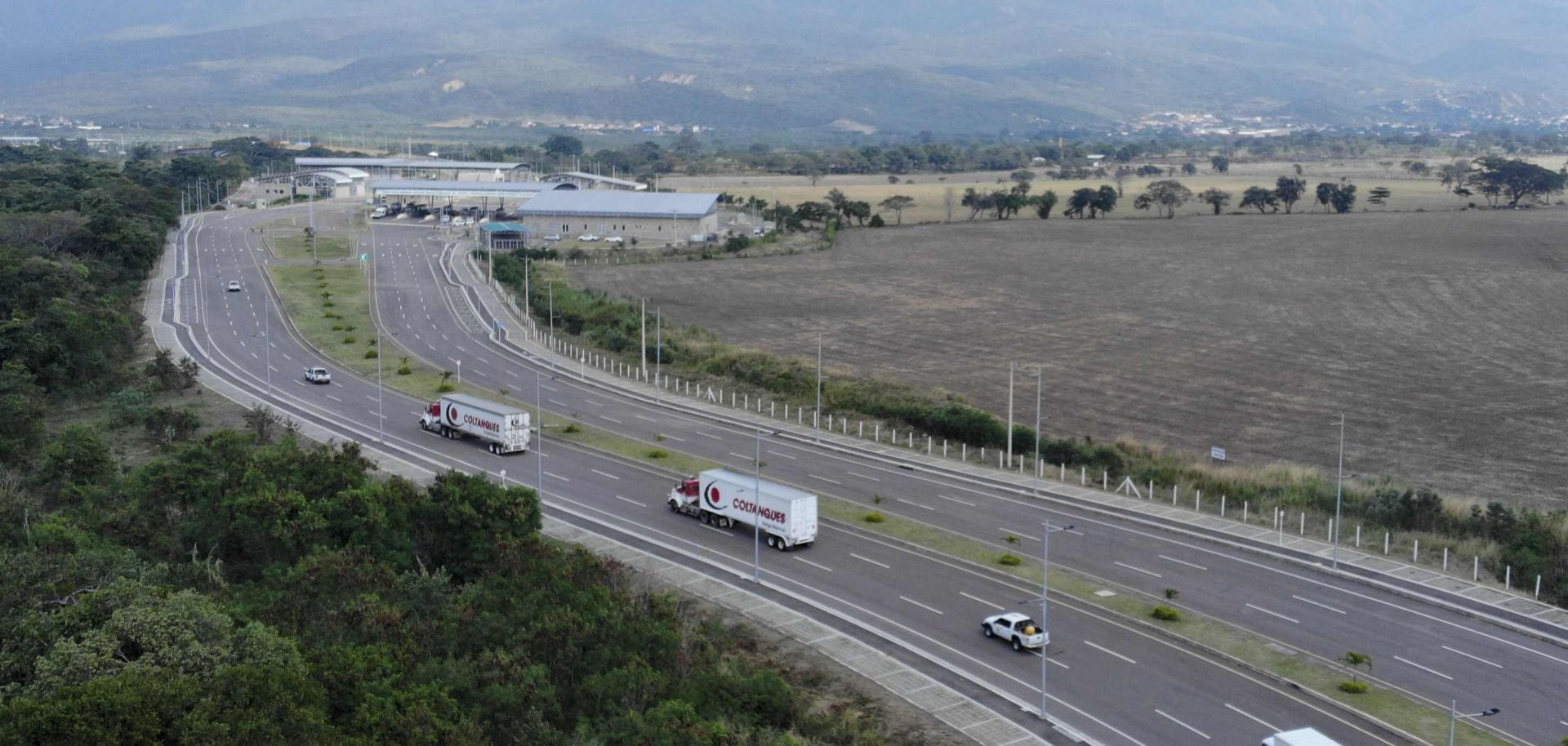
Colombia's National Infrastructure Agency on Sept. 18 launched the latest installment of transportation infrastructure concessions in which the government will invest more than $22 billion in improving and expanding the country's road system over the next two years. The concessions are part of a larger strategic goal to invest nearly $32 billion in transportation infrastructure by 2014 and nearly $100 billion by 2021. Due to royalty and tax reform, Colombia has large fiscal inflows and has run a budget surplus of 1.7-3.9 percent of gross domestic product every year since 2007, allowing Bogota to finance these projects in cash.
After a decade of solid macroeconomic performance, a stable security situation and record-breaking fiscal inflows, it is now possible for Colombia to overhaul its transportation network. Over the next two years, Colombia will invest more in transportation infrastructure than it did in the previous 20 years combined. In 2001, Colombia spent roughly 1 percent of GDP (about $1 billion) on transportation infrastructure. By contrast, in 2012, the government plans to spend roughly 3 percent of GDP (about $10 billion) on transportation infrastructure. If managed properly, by 2021, this tenfold increase in investment will significantly improve Colombia's economic competitiveness.
Colombia's geography and demographics present major challenges to its transportation and trade. In 2011, it cost Bogota $2,270 to export one shipping container, compared to a cost of $795 in Chile and $860 in Peru. Colombia's major economic centers are divided by three major mountain ranges: the Cordillera Oriental, the Cordillera Central and the Cordillera Occidental. Dense rain forests also split the country diagonally, making half of its territory difficult to develop. Together, these mountains and rain forests have historically posed a problem for consolidating and integrating Colombia's national economy.
Additionally, the main economic and population hubs in the country — Bogota, Medellin, Cali, Cartagena and Barranquilla — contain more than 60 percent of the population and 44 percent of non-mining economic activity. These hubs are located in disparate regions throughout the country; Bogota is high within the Cordillera Oriental, Medellin is within the Cordillera Central and Cali is in the valley between the Pacific Ocean and the Cordillera Occidental. With weak transportation networks connecting these cities to each other and to the exterior, logistical costs account for 18.6 percent of total business costs in Colombia — 4.3 percentage points higher than the Central American average. Additionally, the average distance from Colombia's three major cities to maritime ports is roughly 260 kilometers (162 miles), compared to the average of approximately 75 kilometers in Chile and Brazil. While distance is not the primary factor driving up transportation costs, it nonetheless underlines the challenges Colombia faces in becoming more cost competitive.
Colombia's Transportation Initiatives

Four long-term strategic projects are currently under way as part of Bogota's concentrated effort to drive down transportation costs. Currently, Colombia uses roads for more than 80 percent of its internal transportation, which is common for Latin America. However, Colombia's road network continuously deteriorates, which exacerbates bottlenecks and inefficiencies. In 2010, torrential rains destroyed large sections of the country's paved roads, and since 2007, the cost of export per shipping container has increased by 58 percent, jumping from $1,440 to $2,270. Since roads are so important to Colombia's transportation, the first initiative will create four major road systems that will transect the country and substantially improve existing roadways. The government will also expand a number of critical roads from two lanes to four lanes and build bridges and tunnels to improve speed of transport. There are currently 6,000 kilometers of road concessions, which the government hopes to increase to 12,000 kilometers by the end of 2014.

The second project will rehabilitate two major railroad systems — the Pacific Concession (formerly known as the Western Railroad) and the Central Railroad — and will eventually link the two together. The former will connect Medellin and Cali (the second- and third-largest cities in the country) with the Pacific port of Buenaventura, while the latter will link Bogota and the natural resource-rich interior with the port of Santa Marta on the Caribbean coast. These railroads were constructed at the end of the 19th century and gradually deteriorated throughout the 20th century. With half of Colombia's railways inactive or abandoned, this rehabilitation project is less capital-intensive than creating an entirely new railway system.
The third initiative will restore the navigability of the country's major river system, which stems from the Magdalena River. This system used to be an important means of transportation, but throughout the 20th century large stretches of the river (most notably the Puerto Salgar-Barrancabermeja section) became unnavigable. In March 2013, the government will chose six firms to submit proposals for restoring the navigability of the river, specifically with regard to the stretch from Puerto Salgar to Barranquilla (1,000 kilometers in length) and the Dique Canal extension (114 kilometers in length), which connects the Magdalena River to Cartagena. The contract will be worth $400 million over 10 years, and Acciona (Spain), HydroChina (China), Hyundai Engineering and Construction Co. Ltd. (South Korea), Ecopetrol (Colombia), Pacific Rubiales Energy Corp. (Colombia) and Votorantim Group (Brazil) have all expressed interest in submitting a proposal. Once the river system's navigability is restored, it will be capable of transporting roughly 4 million tons annually, half of which would be made up of coal and crude oil shipments.

Finally, the fourth initiative entails investment from the public and private sectors in large-scale improvements to port infrastructure and multimodal transportation hubs. In Cartagena, Buenaventura and Barranquilla, the government has invested $160 million, $122 million and $240 million, respectively, in port expansion and dredging projects. Buenaventura is currently undergoing a $30 million dredging project to bring the depth of the port to 12.5 meters (41 feet) by February 2013. Cartagena's deepest wharf is currently 13.7 meters, meaning it will need additional investment to reach a depth of 15 meters, which would allow access to most post-Panamax ships (ships that are currently too large to go through the Panama Canal). In the private sector, mining companies Prodeco, Drummond and Cerrejon have invested $250 million, $120 million and $140 million, respectively, in their privately owned coal-loading ports. In addition to improving port infrastructure, Colombia is also focusing considerable attention on multimodal hubs. Bogota is building a deepwater river port in Barranquilla to more efficiently transfer goods between the river and the maritime port. It is also investing in a multimodal hub to improve rail, road and river transfers in Puerto Salgar and creating a hub in Yumbo to link its river, rail and road traffic with Buenaventura. Investment in these three nodes will ensure that the bottleneck is addressed comprehensively rather than pushed elsewhere.
Implications
Accelerating investment in the country's transportation infrastructure will have several ramifications. Colombia's major population centers — Bogota, Medellin and Cali — will be more efficiently interconnected, and each will have easy access to a major maritime port. Medellin will benefit most in terms of economic development and international trade, since it will be connected via road and river to the Caribbean coast and via road and rail to a Pacific port.
Colombia's manufactured goods and natural resources — including coal, oil, nickel and agricultural products — will be easier to transport and will be more cost competitive. Additionally, with alternative means of transportation, labor strikes and rebel attacks will have less of an impact on commodity flows and the national economy. However, if peace negotiations with the country's rebel groups fail, increased infrastructure will create a larger target for the government to protect. These investments will put additional pressure on the government to negotiate an end to hostilities with the Revolutionary Armed Forces of Colombia, or FARC.
Finally, Cartagena likely will remain the country's dominant port due to its natural depth, the location of coal and oil deposits in the country, and its proximity to Colombia's primary trading partner, the United States. The dredging of the Dique Canal, which connects the Magdalena River with Cartagena, increases Cartagena's attractiveness as a multimodal hub.
The transportation infrastructure projects reflect Colombia's geopolitical orientation and imperatives. The country will continue to leverage its access to both the Pacific Ocean and the Caribbean. However, with an outlet to the largest consumer market in the world, the Magdalena River Valley will continue to drive Colombia's development trajectory.
