
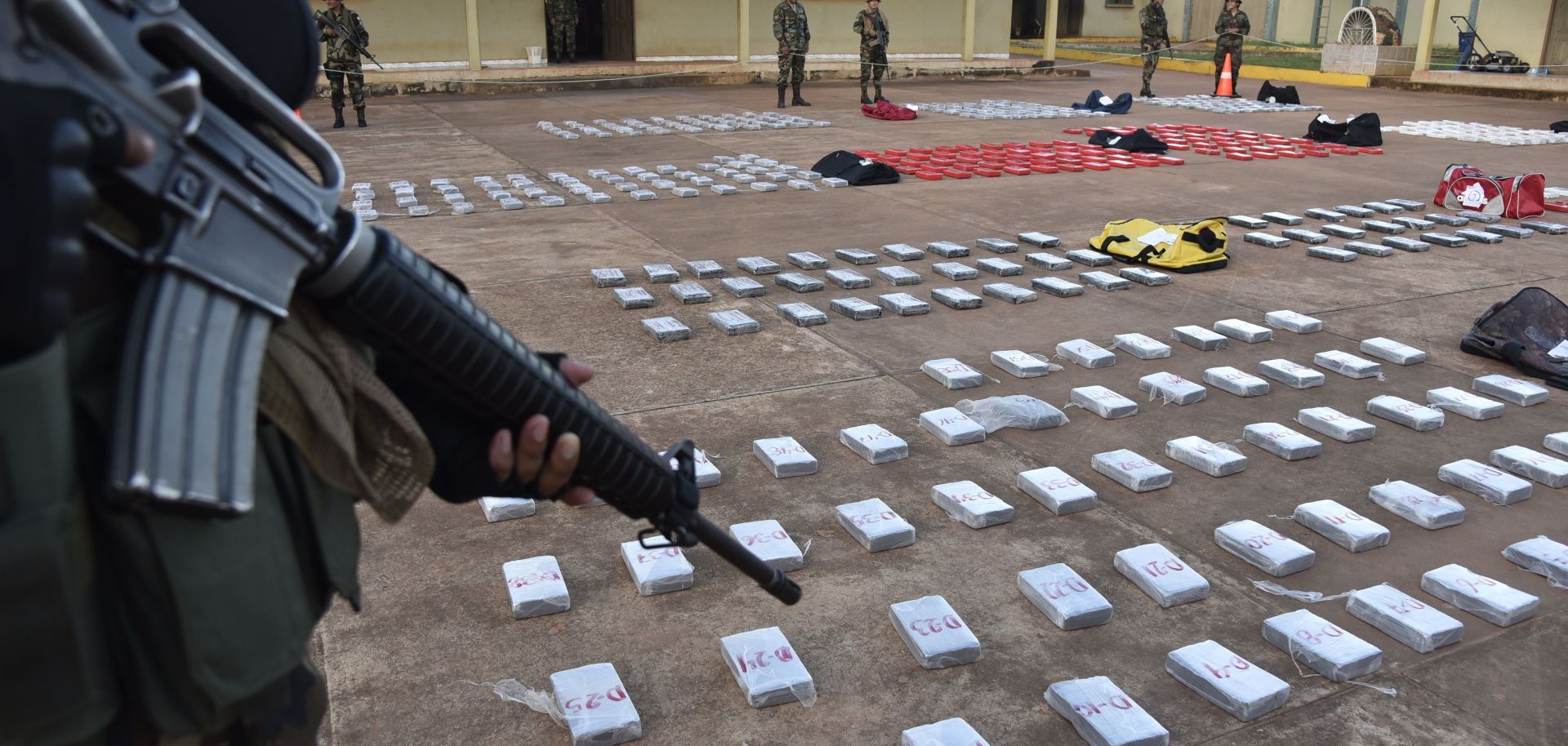
Members of Bolivia's Special Fighting Force Against Drug Trafficking (FELCN) guard 582 kg of cocaine hydrochloride, seized from a ranch -where allegedly was due to be refined- in the locality of Guayaramerin, in the norteastern border with Brazil, on April 17, 2018.
The Bolivian attorney general's office is investigating up to 20 people, including armed forces officers and police personnel, for alleged links to Mexican, Colombian and Brazilian drug trafficking organizations, a Bolivian government attorney said Aug. 14. The investigation reflects Bolivia's growing prominence in South American cocaine production — a trend highlighted by a July 30 White House report indicating that Bolivia has become the second-largest producer of cocaine hydrochloride in the world, trailing only Peru. More notably, Bolivia's production of cocaine HCL — the finished consumer product — has surpassed that of Colombia.
Bolivian drug operations have benefitted from the shift in South American cocaine HCL production that occurred as a result of successful counternarcotics efforts in Colombia. As an ideal alternative manufacturing hub for cocaine, Bolivia has helped to compensate for Colombia's decreased production capacity, drawing increased attention from the governments of Brazil, Argentina and Paraguay. Regional counternarcotics efforts will likely attract support from the United States, but rifts with La Paz will complicate Washington's attempts at direct involvement in Bolivia.
The White House report estimated that both Bolivia and Peru are producing more cocaine HCL than Colombia. Bolivia produced an estimated 265 metric tons in 2011 (up from roughly 195 metric tons in 2009), compared to some 195 metric tons in Colombia in 2011 and some 325 metric tons in Peru in 2010. However, the reported rise in Bolivian and Peruvian cocaine production does not indicate an increase in global production. Indeed, U.N. statistics show that global cocaine production has largely stabilized in recent years, while consumption in the United States — the largest destination market for South American cocaine — decreased slightly in 2010.

Instead, production increases in Bolivia and Peru stem primarily from successful military and law enforcement operations against cocaine producers in Colombia. In past decades, the majority of coca leaves used in cocaine production were grown in Bolivia and Peru and then shipped as coca paste to production labs in Colombia. But increased law enforcement pressure in Colombia began disrupting the country's large-scale cocaine operations in 1999 and eventually prompted a shift in the drug's production to other countries in the region.
Multiple factors make Bolivia an ideal alternative manufacturing hub for cocaine: coca leaf cultivation is already widespread in the country, Bolivian anti-drug trafficking efforts have been limited, and the country is near Brazilian, Paraguayan and Argentine smuggling corridors. Bolivia's uptick in cocaine production has been reflected in the development of the country's cocaine manufacturing infrastructure, including runways and production labs. Cultivation of coca leaf, the base ingredient for cocaine, is especially abundant in the Cochabamba and La Paz departments. Heavy concentrations of cocaine HCL labs have sprung up in the eastern Santa Cruz department and the central Cochabamba department, according to Bolivia's counternarcotics agency.
Bolivian law enforcement officials have launched operations against cocaine production, but with limited success. In May, initial reports touted the seizure of 249 cocaine processing labs during a single week in 2012, but new government figures indicate that law enforcement agencies seized only around 20 labs in the first six months of 2012 and 25 labs in all of 2011.
International Counternarcotics Efforts
Cocaine producers benefit from Bolivia's sparsely populated border regions, which facilitate heavy smuggling activity both overland and through the use of aircraft. Brazil and Argentina are the primary transshipment points for Bolivian cocaine heading to Europe or the United States. According to Argentine authorities, traffickers make approximately 90 drug-laden flights into northern Argentina's Salta province each month, despite radar coverage of the region. According to Paraguayan authorities, three to five flights transporting drugs arrive in Paraguay from Bolivia each week.
The steady drug traffic has drawn the attention of Bolivia's neighbors, and some countries have already launched security operations and negotiated agreements to boost anti-trafficking cooperation. Brazil, Bolivia and the United States implemented a program earlier in 2012 to use satellite photography to monitor reductions in coca-growing areas, and Brazil has already deployed its military on several occasions this year to secure its border regions.
Relations between Washington and La Paz have been somewhat strained, however. In 2008, Bolivia expelled all U.S. Drug Enforcement Administration personnel, complicating U.S. efforts to control coca growth and cocaine HCL production in Bolivia. On Aug. 9, Bolivian Interior Minister Carlos Romero said the Bolivian government would present a diplomatic complaint to the United States concerning the July 30 White House report, dismissing it as ideologically motivated. Bolivian President Evo Morales' government relies on political support from coca-growing unions, which will make it difficult for the United States to obtain Bolivia's cooperation with any efforts to crack down on the cocaine trade.
Over the next several years, Washington may attempt to repair its ties with La Paz, whether working with Morales or with a possible successor elected in December 2014. From the U.S. point of view, Bolivia's growing role as a cocaine supplier undermines gains made during nearly a decade of counternarcotics operations in Colombia. Rising cocaine production in Bolivia ensures a steady supply to global markets, and traffickers can exploit trafficking routes through Bolivia's neighbors as alternatives to Mexican and Caribbean routes.
In the meantime, in lieu of taking direct counternarcotics action in Bolivia (as it has in other countries), the United States will instead focus on supporting efforts by states within the region to curb the flow of drugs from Bolivia.
