
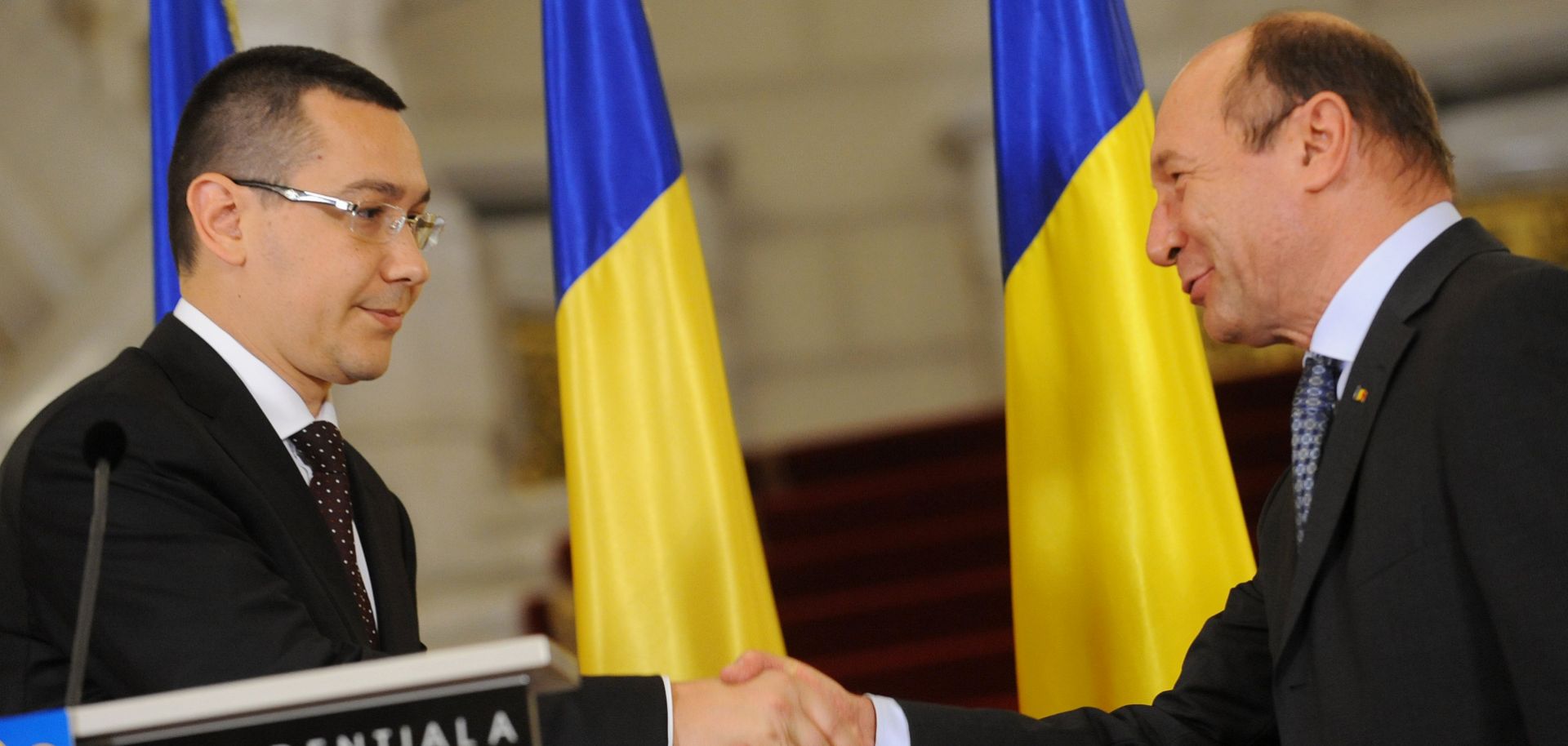
Romanian President Traian Basescu was suspended from office by the country's parliament on July 6. Voters must now approve the removal in a referendum set for July 29. The suspension is part of economic and political uncertainty that has engulfed the country, undermining Bucharest's negotiations with the International Monetary Fund (IMF) and its foreign policy goals with the European Union.
Intense fighting between the country's two main parties, the center-left Social Democratic Party (PSD) and the centrist Democratic Liberal Party (PDL), began when former Prime Minister Emil Boc resigned in January 2012, stripping the PDL of the premiership. As replacement, Basescu appointed independent Mihai Razvan Ungureanu, who in turn lost a vote of confidence in May 2012 and was replaced by opposition leader Victor Ponta of the PSD. Since then, Romania has been ruled by the Social Liberal Union, a coalition that includes the PSD and the National Liberal Party, a smaller faction with limited influence. Ponta's appointment as prime minister broke the balance of power in Romania.
Crisis Origins
Ponta has fought with Basescu and the PDL for the past two months. Basescu previously belonged to the PDL, and he maintains close ties with the party. Similar to France but unlike most of Europe, Romania has a semi-presidential system in which the president enjoys special prerogatives. Basescu represents the country internationally, commands the Supreme Council of National Defense and mediates among different state bodies.
On the surface, Ponta and Basescu's quarrel emerged over the question of who should represent Romania at EU summits. Romania's Constitutional Court ruled in favor of the president, but Ponta defied the decision and attended the June 28 EU summit in Brussels. The dispute between the two leaders, however, is just one part of a deeper fight for control of the country between Romania's main political forces.
In recent weeks, Ponta and the PSD suffered two significant setbacks. First, allegations emerged that Ponta plagiarized his doctoral thesis. The prime minister dismissed the charges as a PDL plot. Second, former Prime Minister Adrian Nastase, a prominent PSD member, was sentenced June 20 to two years in prison for corruption. The PSD accused the country’s judicial system of being politically motivated and dismissed the ruling as an effort to discredit the party before parliamentary elections in November.
In response, the PSD spearheaded legislation making it easier to impeach the president. As a first step, the government approved an emergency decree July 4 that curbs the powers of the Constitutional Court, barring it from ruling on parliamentary decisions and allowing it only a consultative role in impeachment proceedings. Basescu's suspension occurred under this new provision. Another new law approved in late June allows a simple majority of voters to approve parliament's removal of the president (previous law required an absolute majority of the electorate). On July 3 and July 4, parliament dismissed the speakers of the Senate and Chamber of Deputies — both members of the PDL — and the country's ombudsman, replacing them with members of the ruling coalition. Significantly, the president of the Senate is first in line to succeed the country's president.
Most Romanian politicians once belonged to the country's communist regime, and they carry a long history of grudges and political enmity. Rivalries aside, Romanian politics had a tacit rule: a party in power should not attempt its opponent's destruction. Were they to do so, opposition parties would seek vengeance once they took power, creating a cycle that would destroy the system and hurt its main beneficiaries — the politicians. Nastase's prosecution broke this agreement, creating an uncertain future for the Romanian political elite and destabilizing the system. Open political warfare between the PSD and the PDL has begun.
Implications of the Crisis
A political crisis of this magnitude will not be settled easily even after the November elections. The instability will make it difficult for Romania to implement certain controversial economic reforms, including privatizations of public companies, agreed to under the IMF's economic assistance program. Romania's current financial agreement with the IMF expires in March 2013.
The political unrest also will hamper Romania's foreign policy objectives. Foreign governments will not be able to deal with a stable government in Bucharest, undermining Romania's ability to make progress on several sensitive issues such as access to EU structural funds and membership in the Schengen zone. In early 2012, the European Commission temporarily froze structural funds for neighboring Hungary over doubts about the country's institutional situation. (The funds were unfrozen after Budapest backtracked with a series of controversial reforms.) Romania could face a similar situation.
Meanwhile, the Constitutional Court on July 2 notified the Venice Commission, the advisory body for the 47-nation Council of Europe, about what it called virulent government attacks against its judicial independence. On July 4, the Venice Commission expressed deep concerns over the situation, while the European Commission said it was watching the country closely. European Commission President Jose Manuel Barroso shared his concerns with Ponta on July 6.
Romania's two main parties are likely to emerge weakened from their current fight. The PDL already has been discredited by its mismanagement of the financial crisis and its defeat in local elections in June. While the PSD has enjoyed high approval ratings, the accusations of plagiarism against Ponta and corruption against Nastase have hurt its standing. The diminished popularity of the mainstream parties could benefit anti-establishment groups and leaders, most notably the People's Party - Dan Diaconescu and Ungureanu of the Center-Right Civic Initiative. At present, however, these groups are small forces.
The crisis likely will also have additional economic consequences for Romania, which learned July 4 that it officially entered recession in the first quarter of 2012. The country's currency, the leu, has been slowly decreasing in value against the euro in recent weeks. Uncertainty about the future of Romania is likely to undermine market confidence in the country as well.
