
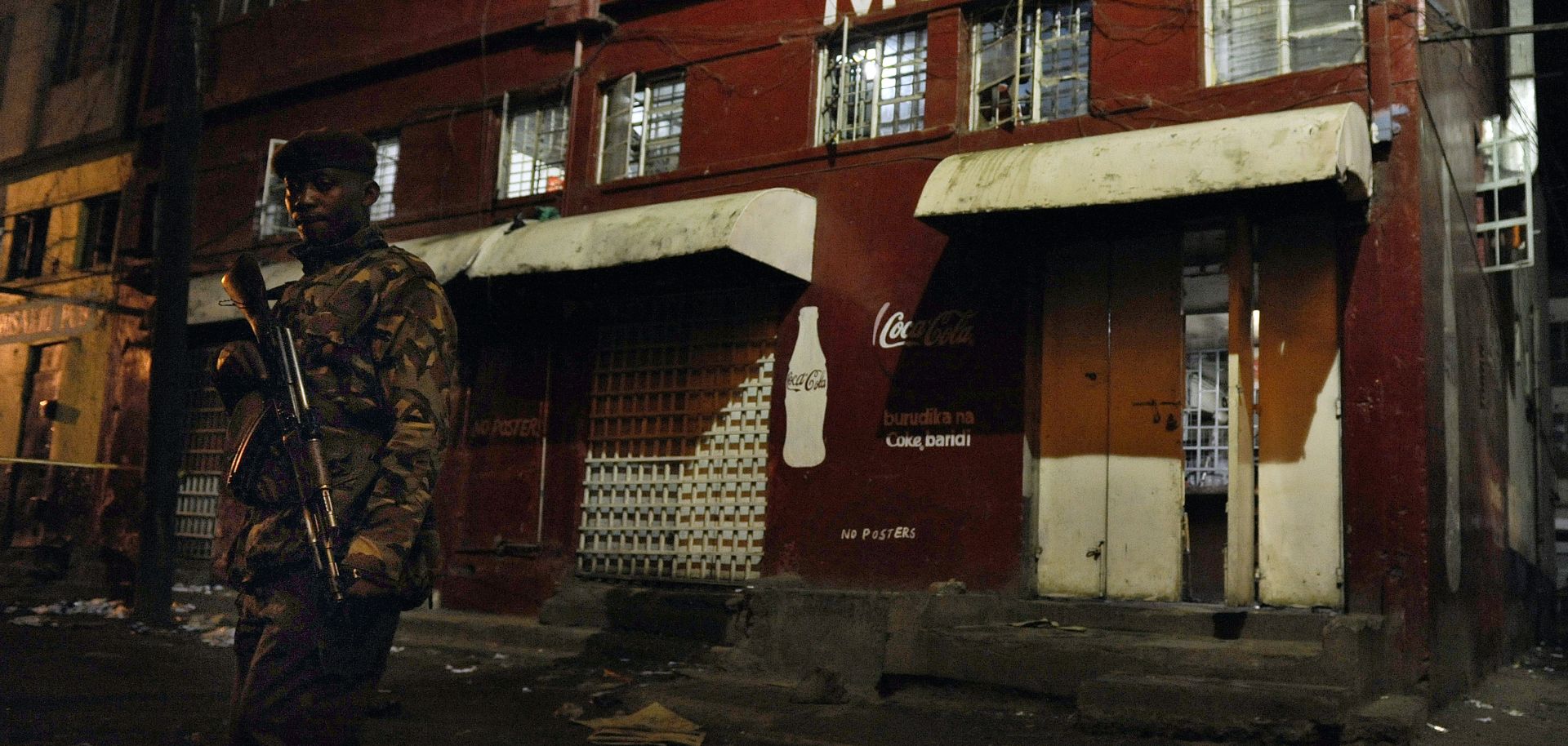
The U.S. government on June 26 refused a Kenyan government request to retract its alert for a potential threat of terrorism in Mombasa between June 22 and July 1. The initial alert came a few days after two Iranians were arrested June 20 in Nairobi. One of the men allegedly led authorities to 15 kilograms (33 pounds) of military-grade explosives. The suspects were charged June 25 with illegal possession of explosives and intent to conduct an attack. The men pleaded not guilty to the charges.
Despite the arrests, the U.S. Embassy in Nairobi has not rescinded its warning, suggesting that there may be more suspects at large. Attacks involving explosive devices have been seen in Kenya before, but they are usually staged by sympathizers of Somali Islamist group al Shabaab, not by Iranians. This and other facts suggest the suspects may have been preparing to deliver the next blow in the covert intelligence war that has raged since 2007 between the United States, Israel and their allies on one side and Iran and its allies on the other.
The travel warning remains in effect even after Kenyan authorities, with assistance from the FBI and Interpol, arrested the two Iranian suspects June 20. One of the men reportedly was flown June 21 to the port city of Mombasa, where he led authorities to 15 kilograms of powder concealed in a plastic bag along a road near the coast. Also on June 21, police in Mombasa impounded a shipping container purportedly containing explosives and suspected to be from Iraq, though it has not been confirmed that the incidents are connected. The 15 kilograms of powder were confirmed June 25 to be military-grade RDX explosives.
The U.S. Embassy in Nairobi in recent months has released similar warnings, many of which have been followed by al Shabaab-linked attacks. However, most of the recent attacks in Kenya have been characterized by grenades or small improvised explosive devices (IEDs) targeting soft targets. In addition, most of those attacks were executed by al Shabaab sympathizers in response to Kenya's offensive to contain the group in Somalia. This latest plot diverges from the normal Islamist activity and more closely resembles the string of Iranian attacks and attempted attacks against Israeli interests in multiple countries.
In response to the assassinations of Iranian nuclear scientists — purportedly the work of Israel — Iran appears to have initiated a largely unsuccessful campaign to strike Israeli diplomatic targets abroad. Israeli interests in Azerbaijan, Georgia, India and Thailand have been targeted so far. The port city of Mombasa is frequented by Israeli tourists and is home to several Israeli-owned hotels and businesses. In fact, al Qaeda attacked an Israeli hotel and an El Al airliner in 2002 in Mombasa. It is possible that Israelis in Mombasa were being targeted again in this recent plot.
Suspicious Details
That the U.S. Embassy has not lifted the warning suggests that the two individuals are not the full extent of the threat. Kenya has witnessed several attacks associated with its operations in Somalia recently (the most recent of which was a May 28 IED attack on a store in Nairobi), but several facts suggest this case is different.
RDX, the type of explosives found along the road in Mombasa, is not often used in attacks in East Africa and is more popular among jihadists and Naxalite militants in India. Additionally, the explosive material was not part of a viable IED — it lacked the blasting cap and firing chain necessary to set it off. At 15 kilograms, the material was insufficient to construct a large IED, but it could have been used to make several smaller IEDs for use in targeted assassinations. This is precisely the approach Iran has taken when targeting Israeli diplomats — with varying degrees of success — in Azerbaijan, Georgia, India and Thailand. (Those IEDs, however, used different explosive materials.) Another similarity to other Iranian activity is the size of the unit involved: Three-man teams have carried out many of Iran's other attacks against Israeli targets.
Iran's Illicit Activities in Africa
Iran has been active in Africa for some time. Tehran and Nairobi in particular have friendly economic and diplomatic ties that they have fostered in recent years. At the informal level, the drug and illicit arms networks that Iranians and Africans facilitate frequently use the port of Mombasa as a point of entry to Central Africa.
Kenya likely serves as an important hub of supplies and logistics coordination for the Iranians. Groups typically do not want to risk their own supply networks, but the attack plot in Thailand, a known logistics hub for Iran and Hezbollah, proved that Iranians are willing to take the risk for the sake of other ends.
Iranians have been caught engaging in illicit activity in Africa several times before. In March 2011, two Iranians and a Pakistani (part of a six-man team) were arrested in Mombasa for their alleged involvement in the heroin trade. In October 2010, two Iranians, one of whom was identified as the commander of the elite Iranian Quds Force's operations in Africa, were discovered running weapons and ammunition shipments through Nigeria. Iran's relations with Senegal and Gambia were strained after it was reported that a number of the uncovered crates (there were 24 total) were destined for the two countries. Reports of such illicit activity reach the media only occasionally, but they are signs of an active Iranian underground network in Africa.
Several elements of the latest plot suggest that it is part of the covert intelligence war between Israel and the United States on one side and Iran on the other. This covert war is only a piece of the larger conflict between Iran and the West — a conflict that includes the crisis in Syria, fears about the Strait of Hormuz, rhetoric about Iran's nuclear activity and diplomatic positioning. In addition to monitoring these elements, it will be important to gauge tensions on the ground, especially as both sides adapt to the covert war.
