
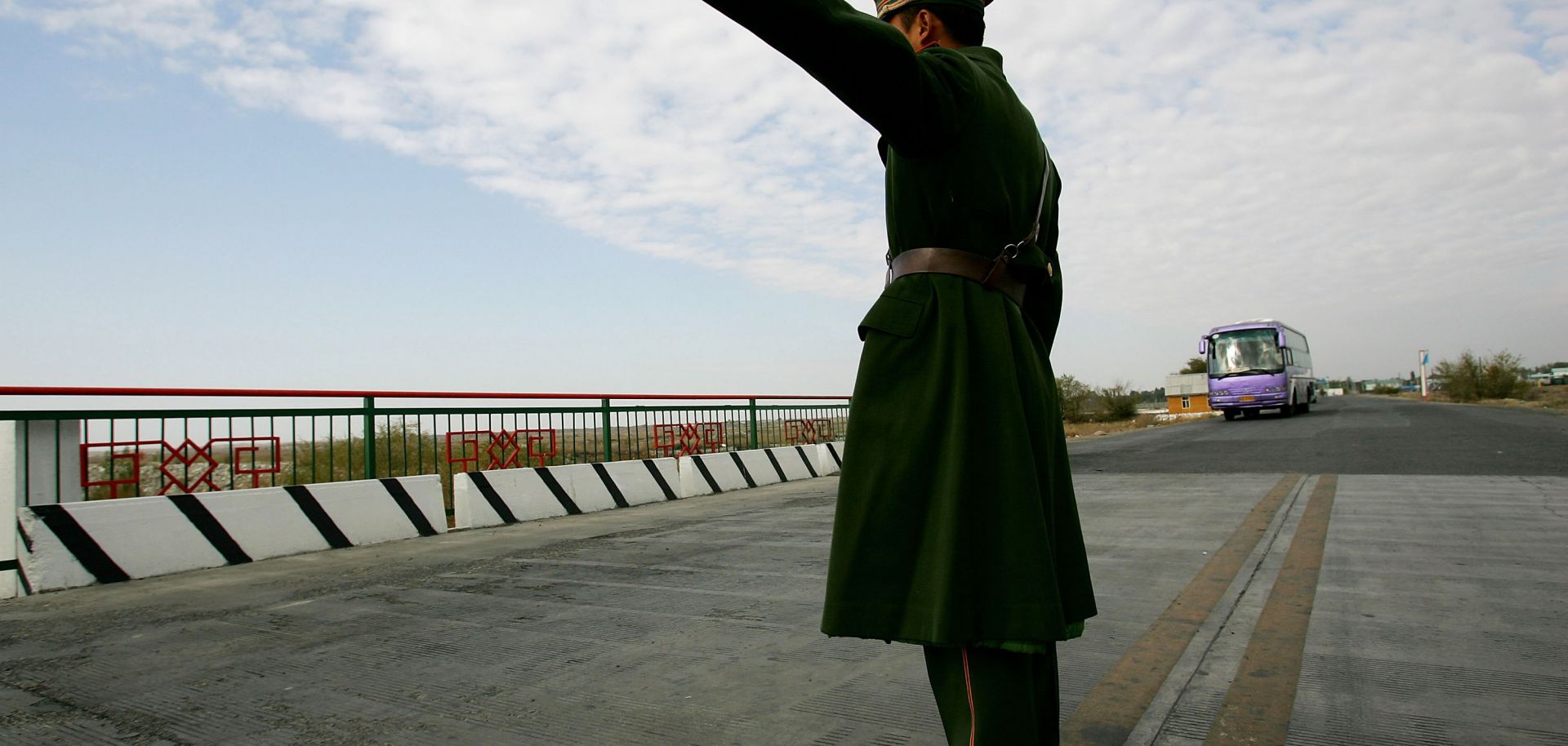
Fourteen Kazakh border guards and a civilian forest ranger were killed May 30 at a temporary post along the Kazakhstan-China border. The cause of deaths in unclear, but on June 7 the only survivor of the incident — a border guard — reportedly confessed to the crime. There may be reason to view the confession with skepticism; the same day, a news anchor with Kazakhstan's Channel 31 television resigned rather than report the official version of events. The deaths could have been the result of a conflict among the border guards, but notably the incident occurred in an area that is seeing more economic development — and therefore more security operations.
Kazakhstan and China have made several economic and security agreements, which have led to increased interaction between the two countries. That increased interaction has put pressure on the local population and on security forces to mitigate the unintended consequences of growing border activity. While the truth behind the May 30 incident remains unknown, securing the border region will become more important as China and Kazakhstan further develop the region economically.
Most of the 1,520-kilometer (940-mile) border between China and Kazakhstan has been relatively calm in the past compared to other border regions in Central Asia. China's Xinjiang province borders Kazakhstan's East Kazakhstan and Almaty provinces, which have about 1.5 million people each, according to the Kazakh State Statistics Agency's 2010 census. They are also similar in size, measuring about 220,000 and 280,000 square kilometers (85,000 and 110,000 square miles), respectively.

Recent Economic Development
Currently there are more than 1,000 joint enterprises with Chinese investments in Kazakhstan, and Chinese President Hu Jintao and Kazakh President Nursultan Nazarbayev on June 6 vowed to enhance the strategic partnership between the two nations during talks for the Shanghai Cooperation Organization (SCO) meetings in Beijing. Besides the development of trade and transportation networks, security cooperation will also increase. Current projects between the two countries include the development of free trade zones and road and rail projects.
There is currently one rail connection between Xinjiang province and Kazakhstan that crosses the border at Alashankou, China. However, China is preparing a "new Silk Road" that will run through Central Asia into Europe, making Kazakhstan strategically essential to China's connectivity plan. The road will complement a new "Silk Track" railway. Also, a high-speed Astana-Almaty railway is currently under construction. China has designated its Yili prefecture in Xinjiang province as a special economic zone to increase trade with Kazakhstan. The border town of Khorgas will be developed as a local trade center with a focus on container transport, processing facilities and the promotion of tourism in Xinjiang and Kazakhstan.
Effects of Development
This development has led to heightened security measures to better control the flow of goods and people across the border. Border regions typically are more difficult for a state government to control than areas closer to a country's core, and people often do not recognize borders in areas that historically have not been strictly demarcated. State-imposed limitations on regions that have traditionally been open can cause tensions between the locals and their governments.
Compounding these tensions, development is not occurring evenly; some areas degrade while others flourish. Traditional hunting and agricultural lands are adversely affected, as are grazing areas that straddle the border regions. This will hurt farmers in the region but improve the ability for traders and smugglers to move goods.
Economic development has compelled Astana and Beijing to increase security to make border control tighter than it has been in the past. Kazakhstan and China have tried to improve border security previously, but now they are more invested due to the economic development that needs security in order to grow. This requires much more energy and resources than security operations would in an area that already has a significant government presence. Security is particularly difficult to achieve in multiethnic provinces, such as Xinjiang, due to tensions between the majority Han and Muslim Uighur ethnicities. Migrant laborers and traders of Uighur, Han and other ethnicities are found along the border region, leading to unease among the locals.
Cross-border ethnic tensions also exist. Kazakhs are typically suspicious of the Chinese, a trait stemming from Soviet propaganda against the Chinese and the fear that China could slowly "invade" Kazakhstan through migration. It is typical for the Chinese government to demand the use of Chinese labor in return for an investment. This allows China to export some of its labor and reduce domestic unemployment. As the number of projects increase, more Han Chinese workers will move into the area and further exacerbate ethnic tensions.
Regional Security Concerns
The Kazakh-Chinese border region is generally calm — there is little reported violence — but as economic activity increases it brings security concerns, including economic disruption and ethnic violence. Both sides are discussing increasing security operations along the border and will be working more closely on issues moving forward. The main security issue in the border region is drug smuggling, though there is some concern about Islamist militancy.
All kinds of products are smuggled across the China-Kazakhstan border. Many licit products made in China are smuggled into Kazakhstan and sold on the black market. But smuggling licit goods invariably leads to smuggling illicit goods, the most concerning of which for China is Afghan-produced heroin. Highways and rail networks are the primary smuggling routes, although small quantities of licit and illicit goods flow easily across open sections of the border where there is little or no security presence. In addition, rising smuggling profits due to development in the border region could entice more locals to get involved. The increase of legitimate trade puts pressure on security forces as they attempt to stem the flow of illicit products move on legitimate trade networks.
Islamist militants could be in the border region, although they have been less prevalent than in other parts of the country. Uighurs are not typically radicalized and have not had any reason to attack inside Kazakhstan. However, China is concerned about instability in Central Asia and the possibility that more contact with Kazakhstan could expose China to greater threats from militants. Both countries are worried about the threat to the new infrastructure being developed since criminal elements, as well as Islamic militants, understand that fixed economic infrastructure is a good target to gain political attention.
As the countries increase security, such as placing new border security posts in the region, greater unease is created between the local populations and security forces. This border will become more important for China and Kazakhstan as potentially disruptive activities grow along with economic development in the region.
