
Video Transcript:
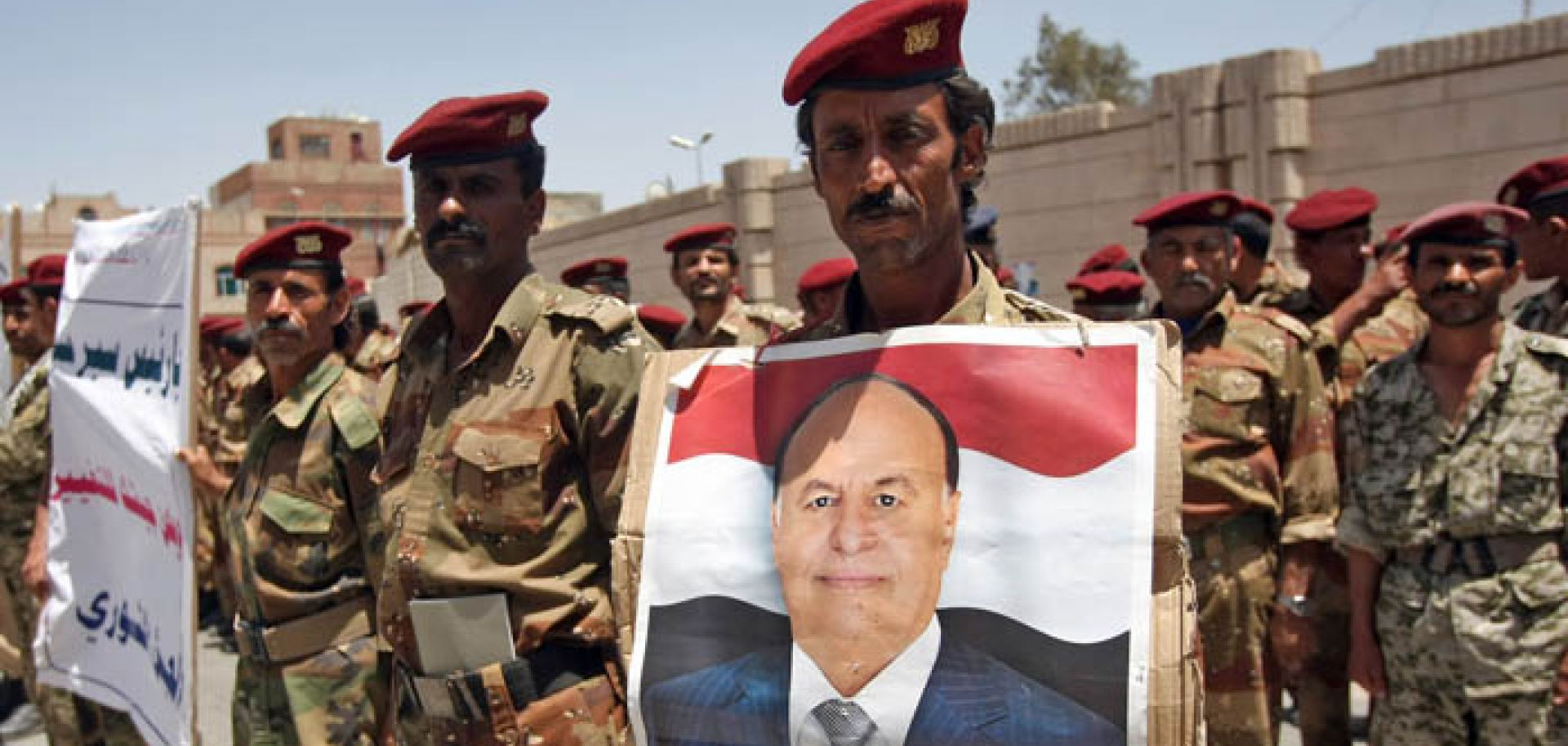
Ground and air strikes against al Qaeda strongholds in southern Yemen are continuing, after dozens of militants were reportedly killed in fighting earlier this week. The Yemeni president's initiative is receiving heavy logistical and air support from the United States. Mansour Hadi's fledgling presidency is fraught with challenges, but the fact that he's taken a neutral stance among Yemen's warring political factions has enabled him to rapidly build a base of tribal support — giving the United States and Saudi Arabia a reason to back his efforts to contain jihadist activity in Yemen.
Abd Rabbuh Mansour Hadi entered the presidency inheriting an al Qaeda led insurgency and the rivaling government and military factions of Ali Mohsen al Ahmar and former President Ali Abdullah Saleh. With no independent support base of his own — or control over the main military and financial arms of the state — he struggled to mitigate the strength of these two factions and their supporters.
The fact that Hadi was not entrenched heavily in any one faction and could claim a more neutral and technocratic stance, has actually helped Hadi gain support. He has been able to gain the backing of groups and individuals fed up with the more than year-long conflict and battling between Saleh and Ali Mohsen's forces. In a show of strength Hadi has begun the initiative to restart the battle against al Qaeda in the Arabian Peninsula, or AQAP.
This initiative was backed heavily by the United States who was skeptical at first of Hadi's ability to consolidate power. However, the U.S. realizes that a weak central government will in no way be able to carry out the fight against al Qaeda in the Arabian Peninsula. In the past few weeks the United States has increased CIA-led air strikes against militants and have actually begun U.S. military air strikes — indicating the overt involvement of the U.S. military. Additionally, the U.S. has deployed Special Forces units into Yemen to train forces and is even providing logistical support for Yemeni offensives from bases inside Yemen. The U.S. is now throwing its support behind the Yemeni government and even more clearly behind Mansour Hadi. President Obama issued an executive order May 16 threatening to impose sanctions on any group or individual thought to be undermining Hadi and the political transition. This is the most blatant illustration of direct U.S. support for Hadi to date.
Saudi Arabia — which shares the U.S. interest in containing AQAP in Yemen — is also strongly backing Hadi and funneling money towards tribes to support this military offensive. We can see this shift in the town of Lawdar in Abyan, where AQAP was once able to operate. Now the tribes are reportedly fighting with the government against al Qaeda. Shifts of tribal support in Yemen can almost always be traced back to financial incentives.
Hadi's offensives on AQAP not only indicate attempts to prove his worth to the United States and Saudi Arabia, but are also strategically coordinated to bolster his political agenda. Much of the fighting has been focused on the southern province of Abyan — one of AQAP's strongholds. Hadi is from Abyan, and he needs tribal support from this province in order to integrate more tribal loyalists into his government as he builds up his own power base. In other words, the Yemeni military offensive in Abyan is very personal for Hadi and his allies.
Hadi still faces his fair share of challenges. There are still a number of military and internal security factions that owe their loyalty to Saleh's family. However, Hadi is expanding control over the purse strings of the state with the Saudi and U.S. support and is using that influence to gradually reassert control over the state. It is the hope of the U.S. that Hadi will be able to stabilize the government enough to allow for a more concerted effort against AQAP, but Hadi is still under serious constraints. Not only is he trying to cope with a crippling economic situation to pay off disaffected tribes and civil servants, he also has to deal with a severely divided military, security and intelligence apparatus and the expected militant and tribal backlash to the current military offensive.
