
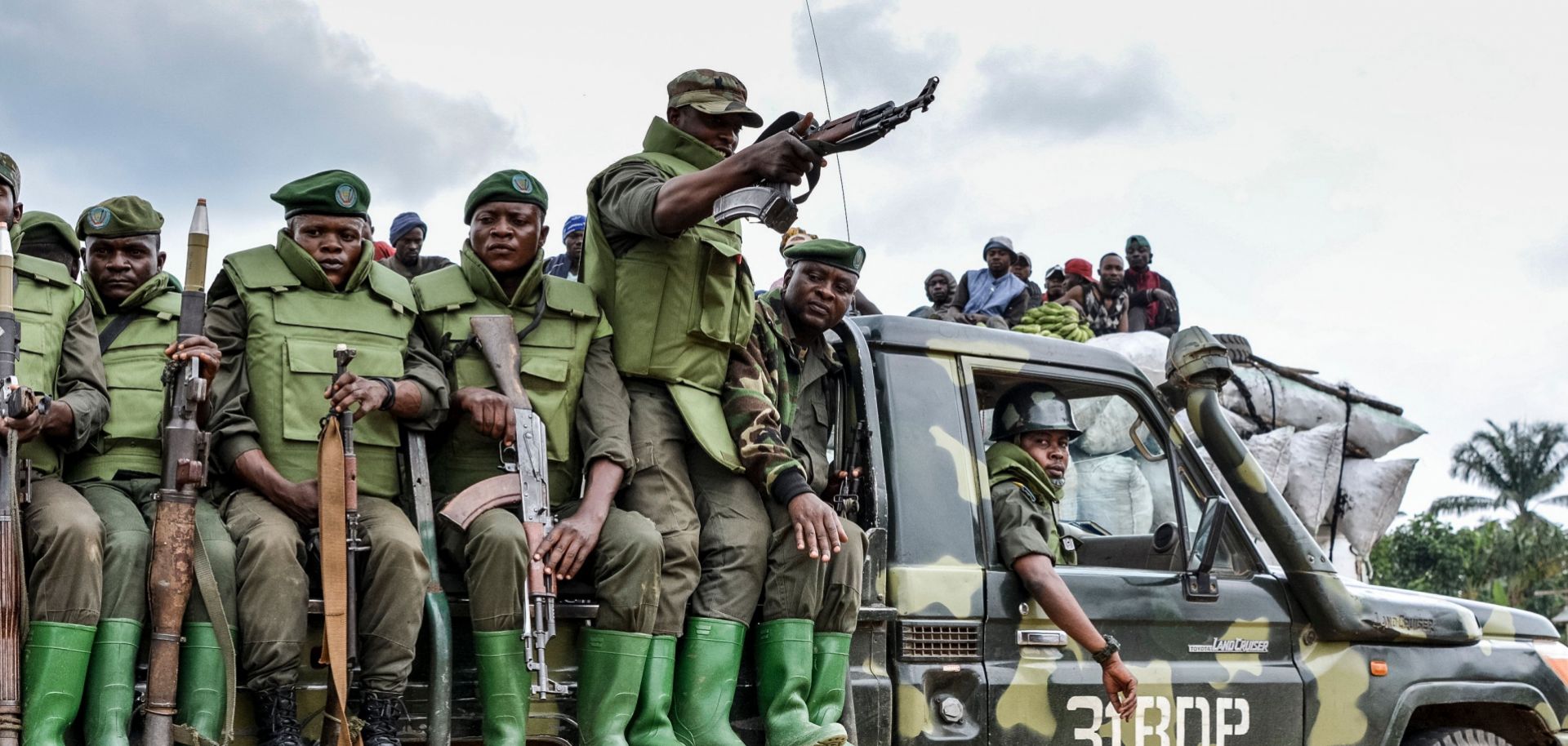
Soldier of the FARDC (Armed Forces of the Democratic Republic of the Congo) sit on a military vehicle in an area of exchanges of fire with members of the ADF (Allied Democratic Forces) in Opira, North Kivu, on January 25, 2018.
The president of the Democratic Republic of the Congo (DRC), Joseph Kabila, in early April deployed some 1,000 soldiers to eastern DRC, the most significant mineral-rich region of the country. In addition to its mineral abundance, this region, which includes North and South Kivu provinces, is also the most ungoverned region of the country; in recent years it has operated beyond the singular control of Kinshasa. Local militias, many of them more loyal to neighboring Rwanda and to a lesser extent Uganda despite being nominally under Kinshasa's purview, control the area with greater authority than the central government.
With the troop deployment, Kabila hopes to replace the leaders of these militias with agents more loyal to Kinshasa. However, hundreds within the DRC military (FARDC) have defected to some of the regional militias, which are re-mobilizing their forces to counter what they see as a challenge to their power and financial resources. The troop deployment is also intended to achieve one of Kabila's main economic goals: increasing Kinshasa's share of revenue raised by the mineral market in eastern DRC, where illicit trading heretofore has favored Rwanda and Uganda. But without assistance from these two countries, which already profit greatly from the mineral trade, the DRC will be unsuccessful in its efforts to assert authority in the Kivu provinces.
Located 1,500 kilometers (about 930 miles) from Kinshasa, eastern DRC historically has been too distant for the central government to fully control. In addition, the DRC's central rain forest acts as a natural barrier, limiting Kinshasa's reach to eastern DRC and orienting the region's trade and people to the east. Thus, militias representing the interests of local ethnicities, some of which span the Ugandan and Rwandan borders, traditionally have governed eastern DRC and have financed their operations with the tin, cassiterite, coltan and gold mines therein. Unsurprisingly, Rwanda and Uganda have long wielded influence in this region and likewise have benefited from the DRC's mineral riches.

Despite its partnership with the central government, the CNDP and other militias have mines in their areas of operation that are independent from the government. At times, the CNDP has even manipulated mineral prices and disrupted the licit mineral trade though its smuggling operations into Uganda and Rwanda. In doing so, such militias as the CNDP have circumvented Kinshasa's tax schemes, cutting the government out of highly sought-after revenue. The CNDP's incorporation into the government military apparatus brought stability to eastern DRC after the civil war, but it did little to curb lost mining revenue.
Reorienting the Mineral Trade
For Kabila, the opportunity to reclaim lost mining revenue came in 2010 under the guise of legal reform. The Dodd-Frank Act, an international law put forth by the United States, forced international companies to recognize conflict minerals, such as those that originated in the DRC. At the risk of forfeiting what revenue it earned from the licit mineral trade, Kinshasa enacted industry reform. In September 2010, Kabila called for a temporary ban on mining activities to reduce illegal mining, launching subsequent initiatives to re-sign foreign mining contracts that further incorporated central government stakes and tax incentives. Kabila understands the government will make more money if it assumes more control over the licit mineral trade.
Ultimately, it was the desire to subsume the mining industry that led Kabila to deploy troops to the Kivu provinces. Such a goal cannot be achieved unless some of the current militia leaders are replaced by leaders more loyal to Kabila. (This explains why Kabila issued an arrest warrant for Ntaganda just before the deployment.) Moreover, it cannot be achieved unless tens of thousands of troops are dedicated to the task. The hope is that the 1,000-member force could help place Kabila loyalists to the uppermost positions of militia power and could help reorient the mineral trade toward Kinshasa. (Reshuffling local military leadership allows Kinshasa to reach out to second-tier leaders who can defer ultimate authority to Kinshasa while maintaining connections to regional players.)
The problem is that several hundred FARDC troops have defected to their former militia: the CNDP. The defectors have seized areas around Masisi, the CNDP's traditional stronghold that is particularly flush with mines. And according to media reports, many of Ntaganda's fellow CNDP commanders, local ethnic groups and Rwandan rebel groups, such as the Democratic Forces for the Liberation of Rwanda, have remobilized their forces and have increased fighting against government forces.
FARDC troops are not fighting their battles alone; they are working alongside U.N. Organization Stabilization Mission in the Democratic Republic of the Congo peacekeepers in Masisi to crack down on militants. But FARDC lacks the manpower necessary to dislodge the local militias. In fact, after already securing parts of Masisi, FARDC called for a cease-fire. It also has given defectors until May 10 to enroll in an amnesty program. Such moves are not demonstrations of power. Rather, they show Kinshasa's inability to control the militias that have proliferated on the eastern edge of the DRC and the continued need to co-opt these forces. Uganda and especially Rwanda would have to assist in Kinshasa's requisitioning of the Kivu provinces, but at present the two neighbors have little reason to change the status quo.
