
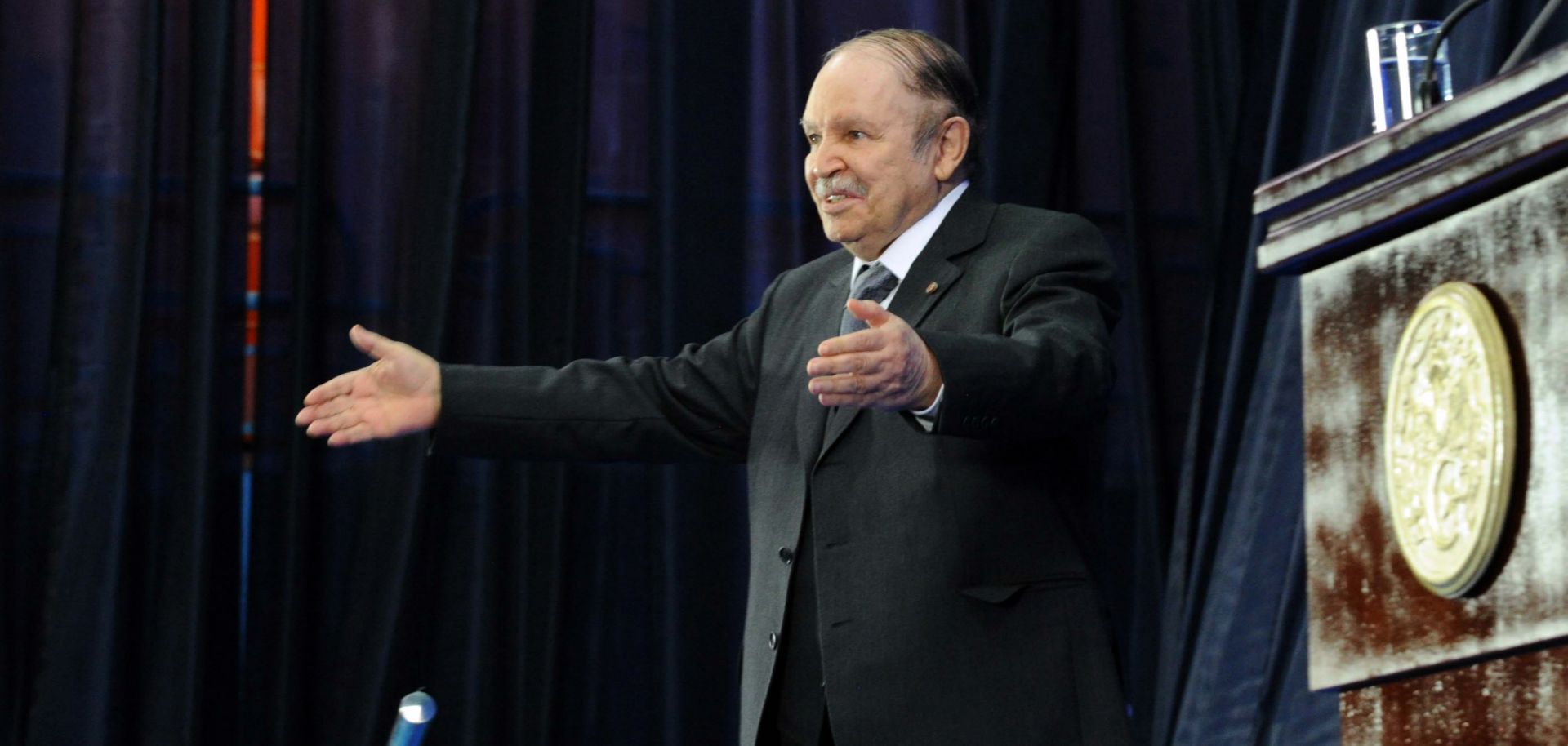
Algerian President Abdelaziz Bouteflika gestures on May 8, 2012, during a ceremony commemorating the 67th anniversary of a French massacre in Setif.
Internal unrest was commonplace in Algerian society even before the Arab Spring. The country was in civil war from 1991-2002 in addition to fighting regional Islamist insurgency and calls for greater political recognition from the Kabyle Berber ethnic minority group. Since the unrest in February and March 2011, there have been several pockets of unrest throughout the country. Algerian media also have reported dozens of self-immolations, all of which had the same consequences: immediate, unorganized low-scale protests quickly put down by a coordinated response by the country's security apparatus.
Several different groups have participated in protests, including Islamists, students and political groups such as leftists and ethnic minorities. Moreover, Algeria's trade unions, a group of highly secular public and private sector employees that have formed a significant political bloc since Algerian independence, have organized several peaceful demonstrations in Algiers demanding increased pay and benefits. The unions are terrified of an Islamist government that itself is internally divided, while the pro-Arab nationalist parties backing the army do not provide a conduit for expressing Berber identity and culture in the political system.
Causes of Unrest
While the protesters come from a broad spectrum of Algerian society, they face the same institutional challenges that usually stem from the fact that the post-independence socialist-leaning ideals of the government are not being met. The unemployment rate is 21 percent, with youth unemployment even higher — a significant factor in a country where more than two-thirds of its population of 35 million is under the age of 35. Moreover, despite the oil and natural gas revenues that have transformed Algeria into the strongest economy of any of its neighbors, the lack of a targeted, effective subsidy system coupled with a complicated duty and tax system has made daily life expensive for the average Algerian. The lack of affordable, basic housing has also been a rallying point for many, and the government's promises to construct new affordable housing have been slow to materialize.
The government-owned company Sonatrach, the largest employer of public-sector employees, controls oil and natural gas exports. However, in 2010 the company fell under the control of the state intelligence service and now operates primarily as an exclusive patronage network of the regime, creating another rallying point for those who want more equal distribution of Algeria's hydrocarbon wealth.
Low Risk for Regime Change
The distance between the protests as well as the lack of coordination, evidenced by the two demonstrations April 29, are considerable obstacles to uniting a formidable opposition against Bouteflika and his government. Protesters also lack cohesion either demographically or ideologically, making it easy for Algeria's sophisticated military and intelligence apparatus, known colloquially as le pouvoir, to keep each group separated from and distrustful of the others.
Bouteflika also has been able to calm rioters with a series of moderate, slow-paced concessions. Chief among them was to permit the Islamists, banned from the political process since 1991, to run in the 2012 parliamentary elections despite a decision in December 2011 to keep the two-decade ban in place. Additionally, Bouteflika lifted the 19-year-old state of emergency, except in Algiers, which allowed for peaceful demonstrations. He also offered the new parliament the opportunity to draft a new constitution by the end of 2012.
Much attention is given in the mainstream media to Algeria's bloody revolutionary war and civil war as impediments to another revolution. However, while the civil war did nothing to deter small-scale unrest, its most significant effect was to fragment Algeria's opposition.
The lengthy civil war and many opportunities to battle Islamist insurgency also have made Algeria's security apparatus, the army, intelligence services and the gendarmerie more powerful and trained to deal with large-scale civil unrest. Le pouvoir has developed an excellent system of managing a divided opposition and faces little threat from a series of small-scale, easily dispersed demonstrations and opposition groups. Bouteflika's largest political concession, the drafting of a new constitution, has ensured growing competition and division within Algeria's multi-faceted opposition, creating a high chance of survival for the regime under the guise of political reform.
