
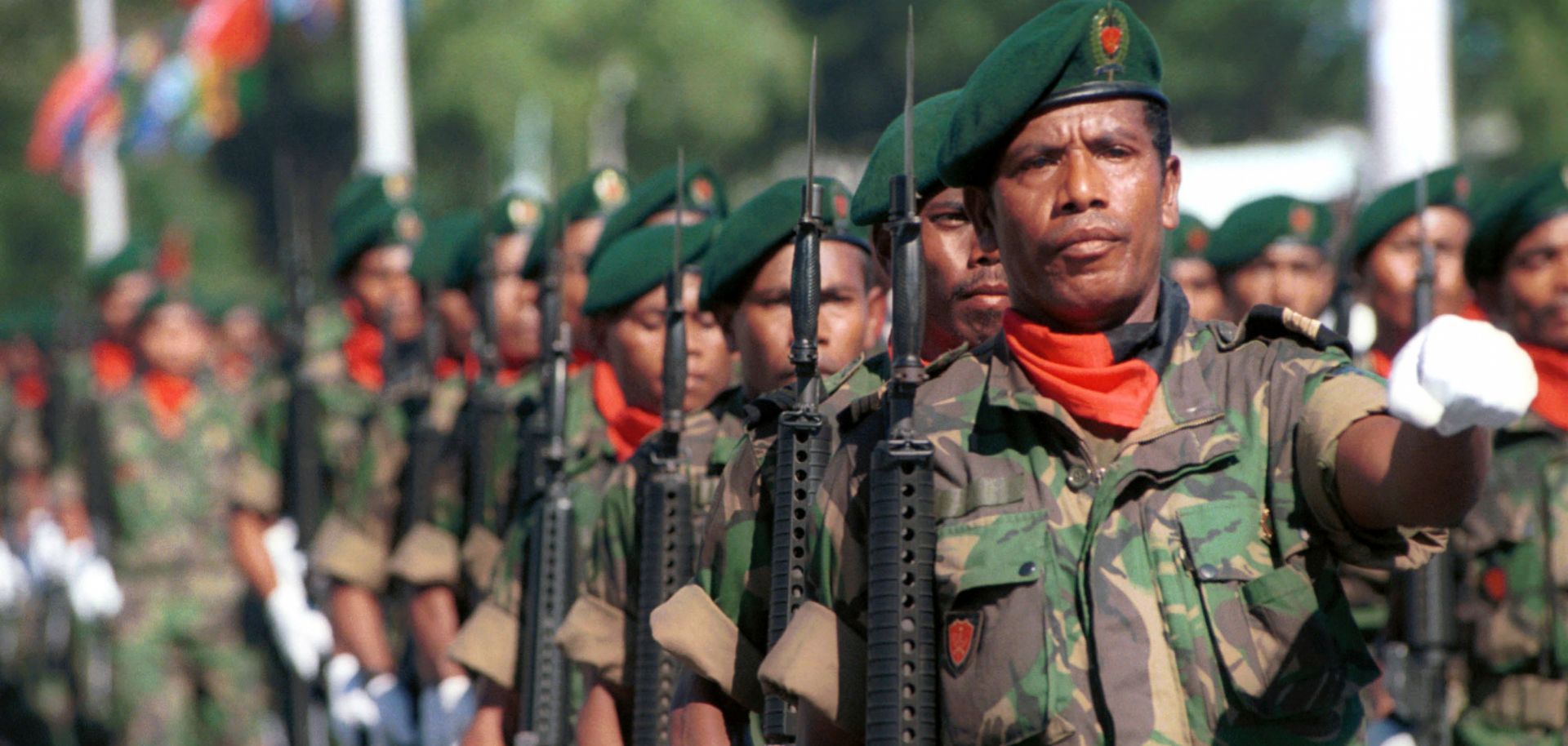
East Timor and China signed a deal Aug. 24 for Beijing to fund and construct a new $8 million military headquarters for East Timor. The move follows China's sale to East Timor of two Shanghai-class patrol boats worth $28 million, along with past investments to build national infrastructure and new government ministry buildings. In a speech following the deal, East Timorese Prime Minister Xanana Gusmao said Dili hopes to strengthen bilateral military cooperation with countries that provide unconditional support and that efforts by other countries to halt East Timor from accepting military training from China were not legitimate.
While never mentioning Australia by name, Gusmao's comments were clearly intended for ears in Canberra. Australia has traditionally considered northern neighbor East Timor part of its sphere of interest and has long provided Dili with economic and military assistance. East Timor, however, considers the aid provided by Australia to be overly dependent on conditions set by Canberra, hence the prime minister's statement that Dili is looking for military partners with less stringent requirements for support. By openly increasing its military cooperation with China, East Timor is sending a message that it has other patrons it can turn to. Beijing has long had an interest in East Timor. China played a role during East Timor's campaign for independence from Indonesia by providing financial support and personnel assistance. When East Timor became fully independent in 2002, China was the first state to formally establish diplomatic relations with the country, and Beijing has since continued to provide aid as a way to extend its economic and strategic presence.
Chinese assistance to East Timor remains small in scale compared to Australia and other countries. However, relations between Canberra and Dili have recently become strained over the location of a natural gas platform constructed by Australian company Woodside Petroleum as well as the Australian Labor Party's push to establish a refugee-processing center in East Timor despite Dili's resistance, leaving room for other players to step in. China's June delivery of the two navy patrol boats, training provided to East Timorese officers and the construction of the military headquarters are all steps Beijing has taken to gain a foothold in the country. Individually, none of these developments are particularly consequential, nor are they representative of a permanent rupture with Australia or a Chinese military buildup off Australia's northern coast.
But collectively, they mark a shift in attitude and are undermining, however slowly, Australia's dominant role in the East Timorese military. From Beijing's perspective, the cooperation with East Timor is part of its strategy to create a sphere of regional influence and acquire maritime security while lessening that of other powers within the region, as well as to gain access to the country's natural resources. Consistent with this strategy, China has been accelerating its steps to expand its presence in other Pacific countries, including Papua New Guinea and Fiji, where Prime Minister Frank Bainimarama recently said publicly that he preferred China's friendship to the West's. It is also attempting to cultivate relationships through regional blocs such as the Melanesian Spearhead Group, an intergovernmental organization consisting of Fiji, Papua New Guinea, the Solomon Islands and Vanuatu, all of which are uncomfortable with Australian dominance and are distancing themselves from Canberra.
East Timor is well aware that Australia's strategic imperatives (and to a lesser extent Indonesia's) require it to maintain a foothold in East Timor and dominate the Timor Sea, a critical waterway to Australia's north, but concerns about overdependence on its neighbor are driving it to seek closer ties with other regional powers. Cash-rich China serves as an optimal choice for the country to counterbalance Australia's power. With other Pacific countries increasingly involved, this competition between China and Australia is likely to shape the regional power balance in Oceania.
