
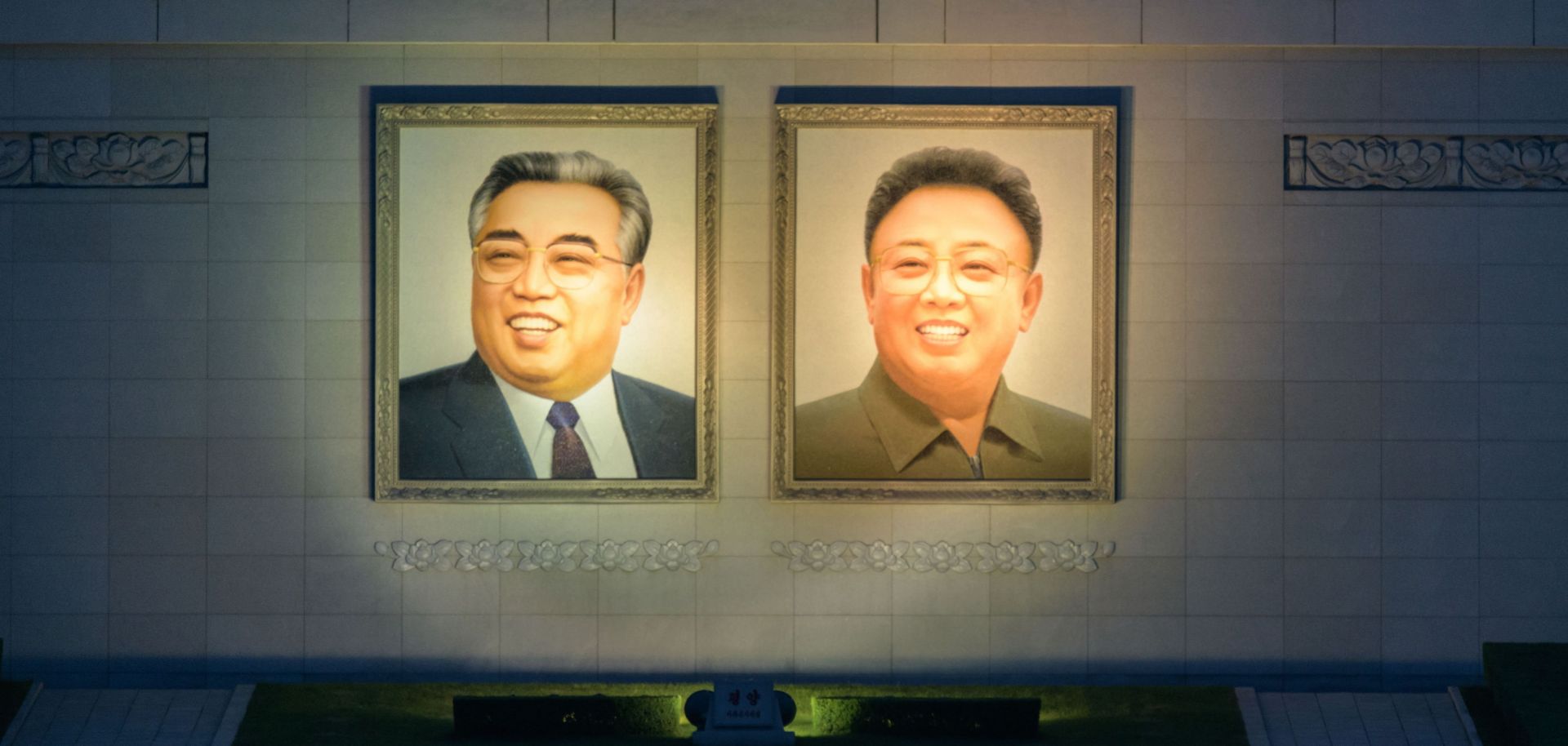
The portraits of late North Korean leaders Kim Il Sung (L) and Kim Jong Il are displayed in Kim Il Sung square in central Pyongyang on June 12, 2018.
Speculation is once again swirling about North Korea's leadership succession as Pyongyang prepares for the elections of Supreme People's Assembly delegates on March 8 and makes final preparations for an announced satellite launch. This is not the first time overseas expectations were raised that North Korean leader Kim Jong Il would finally reveal his chosen successor, but Kim's health issues seem to have spurred him to finally make his selection known. Outside observers have not been alone in trying to presage Kim's decision; members of the North Korean elite have been scrambling to position themselves behind the candidate they think will win, and Kim appears to have used this to identify and maintain a balance among the loose factions.
For years, Kim Jong Il has avoided identifying a successor because doing so would lead to new factional affiliations forming around his chosen son and potentially competing with his own directives. Even Kim Jong Il received admonishments from his father for building his own groups of supporters as he underwent training as the successor. No faction is powerful enough to overthrow the government — Kim Jong Il ensures that, as did his father — but it can complicate and confuse matters.
When it came to succession, it was assumed that Kim Jong Nam, as the eldest son, would naturally be next in line. In 2001, a year ahead of Kim Jong Il's 60th birthday and at the height of North Korea's diplomatic breakout following the June 2000 inter-Korean summit, North Korean media began raising the idea of familial succession, potentially setting the stage for Kim Jong Nam to begin more open training as his father's successor. Shortly thereafter, however, Kim Jong Nam was detained in Japan, allegedly on a trip to the Tokyo Disney Resort and traveling under a false passport, embarrassing the regime and dropping him from leadership contention for the time being. Within a few years, Kim Jong Nam was rehabilitated and succession rumors began to flare anew. Backing Kim Jong Nam was his nominal guardian, Jang Seong Taek, Kim Jong Il's brother-in-law and a rising star among the North Korean elite.
In 2004, rather than announce a successor, Kim Jong Il instead ousted Jang, sending him for re-education, cutting the legs out from under his rising power-base and throwing succession speculators into a state of confusion. When Jang was rehabilitated in 2006, he began again to build support for naming Kim Jong Nam as successor, but also cautiously balanced this with moves to get closer to Kim Jong Nam's two half-brothers, Kim Jong Chol and Kim Jong Un. When Kim Jong Il suffered a stroke in 2008, the slow dance in Pyongyang around his three sons suddenly intensified.
Whether Kim Jong Il has appointed a successor or not, whatever leadership took over North Korea in the event of his death would need one of the sons at least as a figurehead. Jang, who had overseen some of the economic reforms in earlier years, and who is close to China, was the most prominent member of a loose "pro-China" faction placing its bets on Kim Jong Nam's success — and expectations that he would lead North Korea down the path of economic reform and opening to China. Kim Jong Nam, who travels frequently to China and has Beijing's backing, also has support from within the Workers' Party of Korea (WPK), one of the pillars of North Korean leadership structure. The factions are not so much clearly defined groups as they are collections of relationships and people with common interests, and their backing is more about trying to ensure that they are positioned to benefit should their "candidate" son win.
Kim Jong Chol — Kim Jong Il's second son — also had a faction forming around him, this one considered less pro-China and looking instead to reduce dependence on China through closer economic ties with South Korea or smoother political relations with the United States. Among this group are some key military political figures, including Jo Myong Rok, first vice chairman of the National Defense Commission (another administrative pillar of power, independent of the WPK) and the highest-ranking North Korean official to visit the United States.
Enter Kim Jong Un?
Amid these rivalries, Kim Jong Il apparently made the strategic decision to back his third son, Kim Jong Un, as his successor, purportedly notifying officials of his decision around Jan. 8, 2009, Kim Jong Un's 25th birthday. Long rumored to be Kim Jong Il's favorite son, Kim Jong Un is seen as backed by the entrenched military interests, who fear that changing North Korea's economic system will undermine their positions of privilege. Always looking to balance internal divisions, Kim Jong Il may be backing the youngest son to throw off balance the various factions forming around the other two.
There are some reports suggesting Jang, gauging which direction Kim Jong Il was likely to go, had switched his support from the eldest to the youngest son as well. In backing Kim Jong Un, Jang apparently is banking on the idea that, given the likely heir's young age, Jang could serve as a mentor and thus retain influence and power.
As seen with the ups and downs and sideways shifts of Jang's career, factional affiliation in North Korea is an ever-changing thing, and the ability to balance and play factions off of one another is what keeps Kim Jong Il in power, as it kept his father Kim Il Sung in power. By allowing the succession crisis to rage, Kim Jong Il was able to observe the way various members of the elite acted and placed their bets, something he will use as he shifts people and responsibilities around to keep each in check.
If indeed Kim Jong Un emerges from the March 8 parliamentary elections with a parliament seat — which will indicate his standing as the likely successor — Kim Jong Il again will have taken the competition among various members of the elite and used it to keep a careful tension in place, keeping power in his own hands. And rather than give Jang influence over Kim Jong Un, there have been persistent rumors from North Korea and observers in China and South Korea (who also have placed their bets on different sons) that Kim Jong Il may well oversee a live transfer of power around 2012, the 100th anniversary of Kim Il Sung's birth, thus giving Kim Jong Il the ability to sit behind the scenes and pull the strings while his son gets on-the-job training as the next leader of North Korea.
