
Organized crime can be found in almost every country. Many governments have fought organized crime and succeeded in drastically reducing criminal influence within their countries but have never altogether destroyed it. The governments of those countries unable to stamp out organized crime have learned to use criminal activity as a tool or benefit from it through bribes and other forms of corruption. Geography affects organized crime's behavior; Iran, Mexico and Myanmar are prime examples. Beyond that, other factors including a country's infrastructure and the strength of the central government play key roles in determining how pervasive organized crime will be in any given country.
Geography
Iran
Iran's geography is dominated by a land bridge that links the drug-producing areas of Afghanistan and the Caucasus with the Persian Gulf. Considering that Iran is under heavy sanctions and suffering economically, its options for legal trade are limited, and so the advantages of illegal trade become more and more attractive. Furthermore, Western intervention into Iran's drug trade could upset the careful negotiations in Iran's geopolitical standoff with the United States and Europe over Iraq.
Mexico
Two mountain ranges and a desert split Mexico in two and make it very difficult to traverse north of Mexico City. This divide between the Gulf coast (controlled by the Gulf cartel) and the Pacific coast (controlled by the Sinaloa Cartel) has led to a separation in drug trafficking. The rugged mountains and sea lanes make for excellent shipment routes for drugs coming from Colombia (the biggest cocaine producer in the world) going to the United States (the biggest cocaine consumer in the world). The two cartels largely respect each other's coastal territories until they meet at the U.S.-Mexican border. Here, the two cartels fight fiercely over points of entry into the profitable U.S. market.
Myanmar
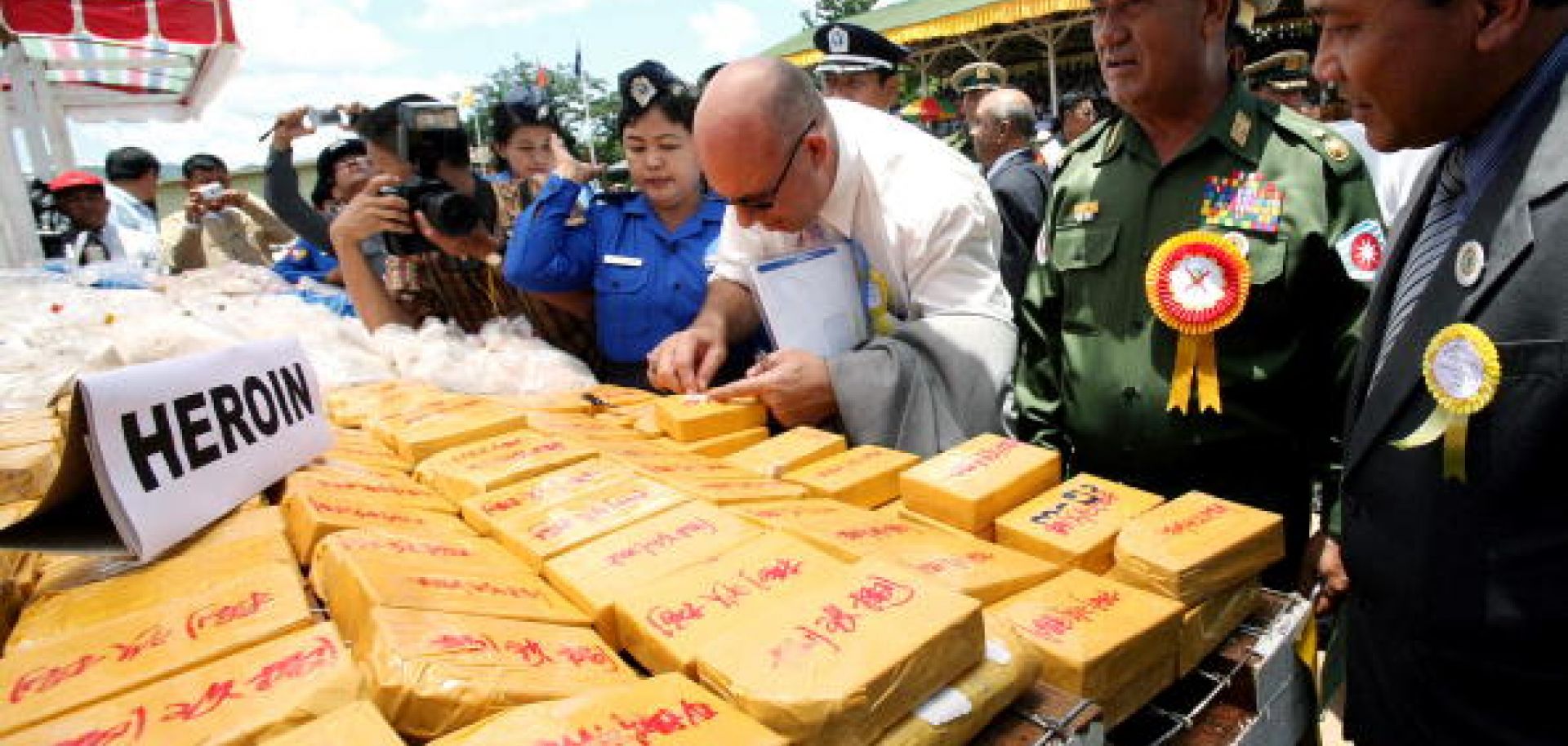
Like Mexico and Iran, Myanmar benefits from the drug trade by being an intermediary between producer and consumer. Meanwhile, drugs and illegal factories (along with a modest oil and gas industry) keep the Myanmar junta alive. Myanmar is the second-largest producer of opiates, according to the U.N. Office on Drugs and Crime, and it also sits next to two major economies where drug use is rising sharply. China and India are Myanmar's two biggest neighbors and, while the continued flow of drugs across their borders with Myanmar irritates them, neither has shown much intention to address the problem (though China has sent some troops to its border with Myanmar). This is partly because at least some of the illegally manufactured goods smuggled from Myanmar actually benefit its neighbors.
The Roles of Governments and Infrastructure
Organized crime and governments have a kind of symbiotic relationship. Like any other organized body, organized crime does not thrive for long in a failed state. Places like Somalia or Sudan, for example, are rife with crime, but in situations like these, warlordism is perhaps a better description of the power structure. Organized crime needs roads, sea ports, airports, banks and legitimate businesses in order to thrive. There has to be a basic level of order in an area so that criminals have paying customers and victims — after all, organized crime is a business.
If, for example, a state has no effective police, then the barrier of entry into organized crime is too low. Anyone can break the law, and so there is little money to be made from doing so. If the infrastructure of a country is a shambles, then criminals are unable to communicate, travel and launder their money. Plus, criminals want to enjoy the money that they do make. Having millions of dollars is great, but it does not do you much good if you are stuck in the middle of a barren desert.
Criminals want to enjoy the same things that virtually every businessman does: material possessions, a nice lifestyle and connections to a global network. This can only be achieved in an area that is relatively stable and has a decent infrastructure, which means that organized crime requires a country with a functioning central government.
On the other side, governments also rely on organized crime — especially governments ostracized by the international community such as Iran and Myanmar. South Africa under apartheid relied on police corruption to add to state coffers; during food shortages, the Soviet Union relied on organized criminals to provide basic goods. Organized crime is very efficient, and governments in times of trouble will turn to what is efficient. When governments are weak, they have little to gain by combating organized crime; in fact, they risk serious violence and state destabilization.
In the case of drugs, there is an especially interesting dynamic. When countries are poor they are much more willing to turn a blind eye to smuggling of drugs and other contraband since it raises revenue (and they are unable to wipe it out in any case). But when countries become wealthier, their citizens start to consume some of the drugs themselves — hurting productivity and putting a burden on public health systems. Furthermore, cheap, illegal contraband competes with the country's own fledgling industries. Wealthier countries are not pleased by this and so begin to crack down on organized crime.
For a long time, China ignored drug trafficking out of Myanmar because it usually flowed into other markets, allowing the Chinese to take a cut of the profits. But since Chinese disposable incomes have gone up, drug consumption has also gone up — spurring authorities to clamp down by stationing troops along the border. Despite the political will to crack down on drug trafficking, China lacks the physical ability to stop it altogether.
Cracking down on illegal trade once networks and markets have already been established is not easy. Drug traffickers and other smugglers entrench themselves along routes and use the money that they raise to secure their business operations among local law enforcement and residents. Areas that have been neglected by the government have a higher tolerance for criminal activity — especially if those criminals provide cash and resources. If organized criminals manage to co-opt local inhabitants and the local government, it makes the central government's job that much harder. In Mexico, for example, the central government has had to send in the military to even get a foothold in areas overrun by the cartels. Crackdowns like this have occurred in many countries many times over the years; the government rarely succeeds in wiping out the trade altogether. Once criminal activity subsides to a level that is palatable to the central government (or once the government is exhausted by its battle), the two sides will return to their state of symbiosis.
As STRATFOR continues to monitor organized crime across the world, the characteristics of geography, infrastructure and government collusion will be recurring themes in our analyses. It is important to remember that organized crime groups do not operate in a vacuum. They must consider the issues of logistics, hostile opposition and the geography where they operate. A lucrative (if illicit) career awaits those able to master these problem sets.
