
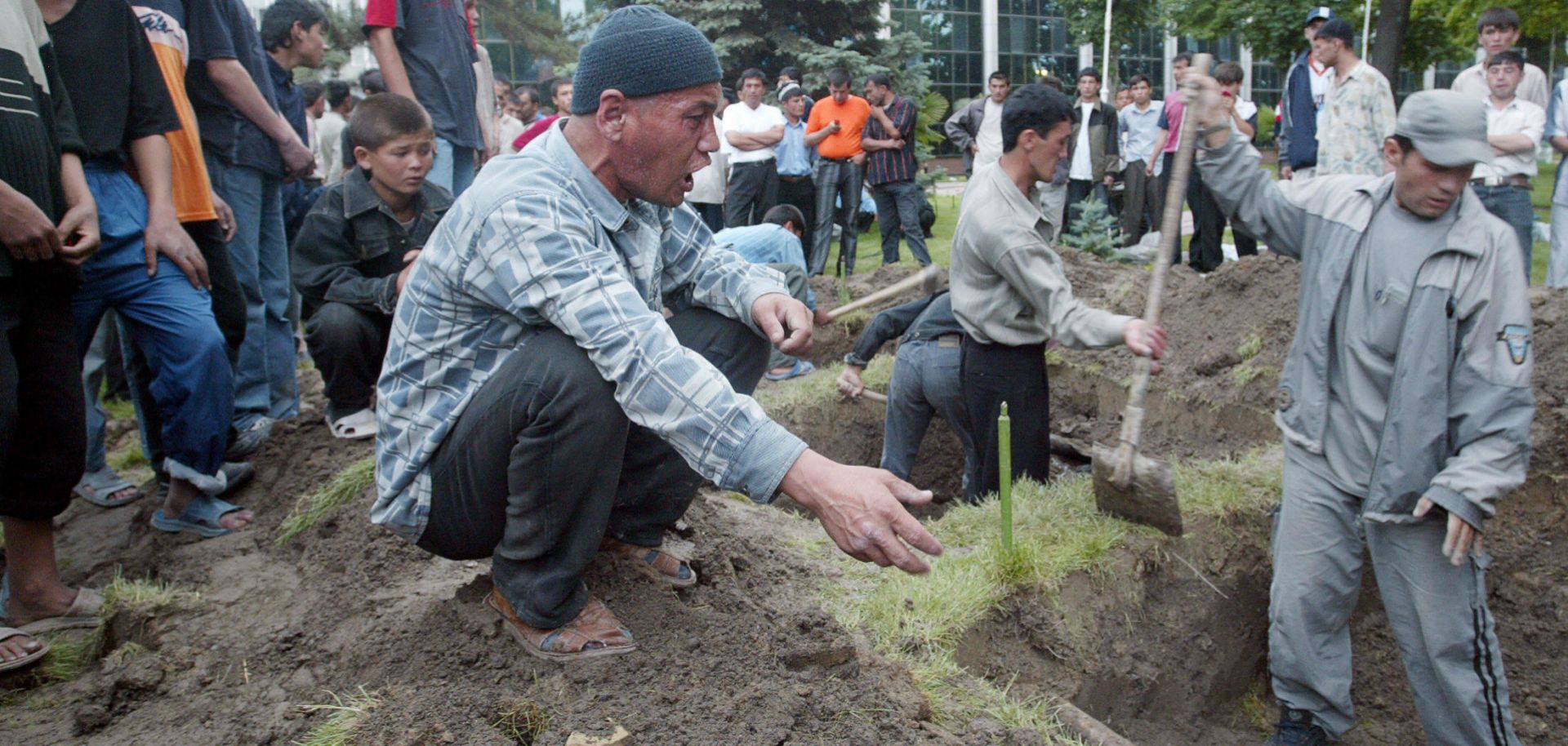
On May 13, after armed civilians stormed the Andijan city prison and took over the regional administration building in the city's main square, security forces in armored personnel carriers surrounded roughly 2,000 protesters. In the morning, the forces opened fire at the protesters, killing nine and wounding at least 34 others. Sources in Andijan say negotiations then ensued between the government, led by Interior Minister Zokirjon Almatov, and the leaders of the armed demonstrators inside the building. (According to unsubstantiated rumors, President Islam Karimov also participated in the negotiations.)
Almatov reportedly offered the leaders safe passage out of the country to Osh, a city with a large Uzbek minority just across the border in the Kyrgyz portion of the Fergana Valley, but the leaders refused the offer. At one point, witnesses allege, the armed groups inside the building attempted to leave with 10 captured policemen, some of whom were injured, at which point the forces again opened fire at the crowd. Residents of the city now report that hundreds lie dead in the square, among them women and children. Though the government claims it has the city under control, local journalists continue to report hearing gunfire in the city center.
A Necessary Evil for Karimov?
It appears that Karimov, who had flown from Tashkent to the Andijan airport with Almatov and other top security officials to monitor the situation, gave the order to fire at the crowd. In reality, Karimov had little choice if he wanted to maintain the government's control over the country. In the revolutions that occurred in Georgia, Ukraine and Kyrgyzstan, the unwillingness of the authorities to fire at protesters only emboldened them and led to the eventual removal from power of those countries' leaders. By demonstrating that the government is willing to kill civilians to maintain power, Karimov has drawn a line in the sand for all to see, much like China did in 1989 in Tiananmen Square.
A key difference between the velvet revolutions and the events in Andijan, however, is that the latter essentially constituted a rebellion in which armed groups initiated the violence by directly engaging government forces. Though the scale of the force used to end the uprising may appear extreme, the government was largely forced into a position where it had to use violence to maintain its legitimacy. Failure to do so would have invited armed revolts elsewhere that could have escalated into nationwide fighting. The fact that an armed revolt has occurred in Andijan has not been lost internationally on governments with an interest in the region. The Russian government has said that the events in Andijan are an internal affair and expressed its hope that the situation would calm down. The U.S. government advised Tashkent to use restraint in Andijan and implicitly criticized the leaders of the uprising by saying Uzbeks should pursue more freedom peacefully. Sources in the Uzbek Interior Ministry have confirmed STRATFOR's expectation that the uprising was the result of rivalry between Andijan and larger Fergana Valley clans and the Samarkand-Tashkent clans led by Karimov.
The violence in Andijan was preceded by the trial of 23 wealthy entrepreneurs on trumped-up charges of membership in the banned Akramiya Islamist group and the arrest of protesters demonstrating against their detention. Uzbek clans tend to be an intricate patchwork of legitimate businessmen, mafia members or drug traffickers, regional political officials and possibly reform-minded political activists as well as Islamists. According to Interior Ministry sources, however, this uprising was primarily a battle over assets that the government was trying to confiscate. The 23 entrepreneurs had established a charity that had so far donated $20,000 to local schools and social programs, and it appears the government wanted to seize the charity's assets, in addition to material belongings such as cars taken when the 23 were arrested. The uprising was largely a message to Karimov and his clan that they should keep their hands off the Andijan clan's assets. Sources in the Interior Ministry believe the uprising could have in part been orchestrated by the United States as a warning to Karimov that he should step down or face more armed uprisings elsewhere in the country.
Though the United States has not supported armed groups and tactics in recent regime-change efforts, it would be consistent with U.S. tactics for Washington to try and win over disaffected clans and elite groups in Uzbekistan and back them in an effort to unseat Karimov, whom the United States would like to see replaced. Similar tactics tipped the scales in Ukraine's Orange Revolution, when most of the Ukrainian elite was persuaded to support Viktor Yushchenko. Separately, Russian government sources say they believe Saudi security services are more responsible for organizing the events, and that the Saudis and Americans could have an agreement to try to install an Islamist pro-Western government acceptable to both sides in Tashkent. On May 12, Russian Federal Security Service Director Nikolai Patrushev said U.S. and Saudi secret services are actively working through nongovernmental organizations to achieve regime change in the former Soviet Union.
A Loss of Legitimacy
In any event, Tashkent will have to explain the decision to fire at the crowd. The government already is saying the uprising was staged by criminals and felons and will likely stick to that explanation, though Karimov might also blame unnamed foreign elements and Western political influence in the region as a warning to them not to interfere. Nonetheless, in the eyes of the Uzbek population, any lingering notions that Karimov's authoritarianism is a necessary evil to confront jihadist threats to the country will now vanish, which can be a useful tool for those who would challenge him. Without any political legitimacy, the only thing to keep Karimov in power now are the security forces at his disposal, and he appears to have them under his control. Karimov now will likely have to pursue the leaders of the Andijan clan to demonstrate to the rest that armed rebellion will not be tolerated. He will moderate that response to some degree, however, since the threat of annihilation would leave the Andijan clan with no choice but all-out resistance that could spiral out of control and lead to mass uprisings.
Interior Ministry sources report that the attacks in Andijan were likely a warning shot to the government (any foreign government involvement aside) by the Andijan and broader Fergana Valley clans in which Andijan leaders are prominent. They are capable of larger attacks, and both sides know this. Tashkent then will probably go after the armed individuals who participated in the attack and make examples of them while trying to negotiate with clan leaders. He will try to make peace with the Fergana clans if that is at all possible. In order to do so, however, he will need to abandon some of his ambitions in the region, and he may then run into trouble with his own clans. The Samarkand-Tashkent clans that form Karimov's support base have been making increasing demands for spoils and power in the last year. Rumors abound that Karimov is ailing, and talk of succession is rife within ruling circles. Karimov's supporters likely would not tolerate any sharing of influence with rival Fergana clans even if he is willing to make such a deal.
Karimov, then, finds himself in a very difficult position in which he most likely cannot satisfy both sides. Faced with a choice, he likely will play it safe and opt to satisfy his own supporters. STRATFOR predicted at the end of 2004, when a large rally struck the northern Fergana Valley city of Kokhand, that this exact dilemma would lead Karimov to side with his own clans against those of the Fergana and thereby cause further turmoil. Events in Andijan support that conclusion. Since the same conditions remain, this trend is likely to continue. Tashkent will probably crack down even harder to restrict political activity and the media in the country.
Rightly or wrongly, Interior Ministry sources report that Karimov thinks some foreign governments, probably Saudi Arabia with indirect encouragement from Washington, have helped organize the current rebellion on a strategic level and are working to overthrow Karimov one way or another. The Uzbek government suspicion is that they struck a deal to support a Fergana Valley supraclan as a geopolitical tool to remove Karimov. In general, then, the country is likely to further isolate itself from the outside world, or at least the West, to limit potential foreign influences on its domestic politics. Meanwhile, the clans in Fergana, and perhaps elsewhere, could be gearing up for the next fight.
