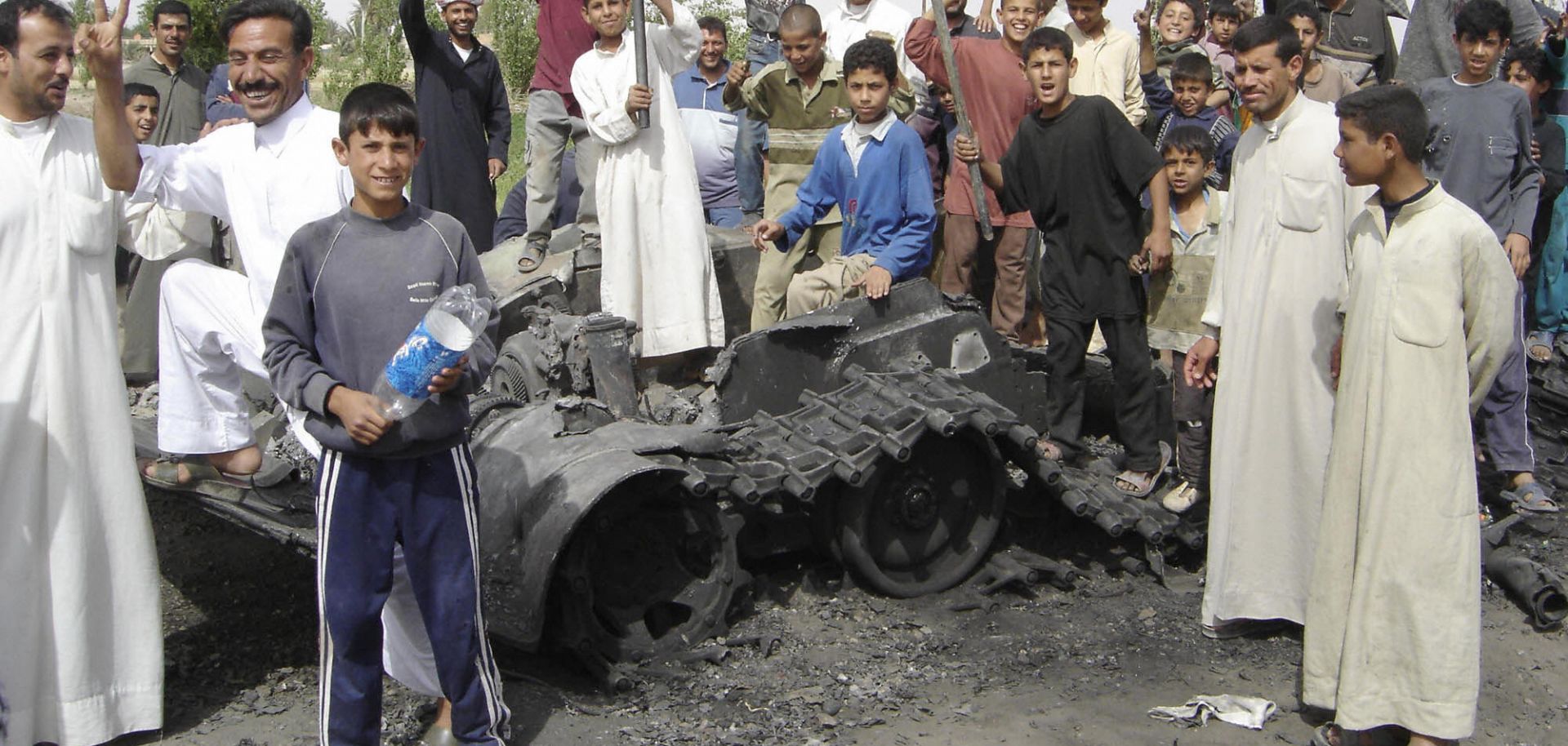
KARABLA, Iraq: Iraqis cheer as they pose for the camera near what they say is a destroyed US military vehicle in Karabla in the al-Qaim district close to the Syrian Iraqi border, 15 May 2005. The vehicle was destroyed during the week-long US military offensive code-named 'Operation Matador' in the al-Qaim area 350 kilometres (280 miles) west of Baghdad, in the Sunni al-Anbar province. The large-scale offensive was launched to flush insurgents out of the area and disrupt their supply routes to Syria, ended yesterday, the military announced AFP PHOTO/ALI KAMAR (Photo credit should read ALI KAMAR/AFP/Getty Images)
Operation Matador, an offensive against jihadist insurgents in western Iraq, entered its third day May 10 with U.S. Marines claiming to have killed more than 100 insurgents along the ancient smuggling trails — so-called "rat lines" — supplying foreign fighters from Syria. The operation, which is the largest U.S. offensive since the assault on Al Fallujah in November 2004, comes as the political and military pressure increases against Abu Musab al-Zarqawi and his militant jihadist group al Qaeda in Iraq. The U.S. military reports that three Marines have died in the operation so far, and The Associated Press reports that 20 Marines have been wounded. Al Qaeda in Iraq issued a statement over the Internet on May 10 discounting U.S. claims of insurgents killed in the operation and stating that U.S. suffered much higher casualties. The 2nd Marine Division's mission in Operation Matador resembles that of the 1st Marine Division when it executed Operation River Blitz in March. During that offensive, the Marines, along with Iraqi units, rolled up insurgent sanctuaries along the Euphrates River west of Ar Ramadi. Operation Matador began on the night of May 7 when U.S. Marines entered the town of Al Qaim, on Iraq's border with Syria. As they conducted a sweep, Marines killed six insurgents and detained 54 suspects. According to the U.S. military, the Marines acted on intelligence obtained from a captured al-Zarqawi associate.
As the offensive entered its second day, fierce fighting erupted around Al Qaim, prompting the Marines to call in close air support. Air Force F-15E Strike Eagles dropped laser-guided bombs and fired more than 800 20 mm cannon rounds at insurgent positions. In response to the intrusion, insurgents mounted a counterattack in the vicinity of Camp Gannon, the Marines' base near Al Qaim. A Marine convoy came under attack from small arms, rocket propelled grenades (RPG) and roadside bombs. In a display of insurgent "combined arms," two suicide car bombers also attacked the convoy. A Marine tank engaged one of the suicide car bombers and destroyed the vehicle and its inhabitants. One armored Humvee was damaged but no Marines died in the engagement. As U.S. troops continued raiding desert safe houses and hideouts over the next two days, fighting was reported in the towns of Obeidi, Rommana and Karabilah, all about 185 miles west of Baghdad, where dozens of well-armed insurgents fired at Marines from balconies, rooftops and sandbagged bunkers. The U.S. military has made no secret of the fact that the offensive targets al-Zarqawi's group.
The U.S.-led coalition and Iraqi government have issued increasingly confident statements about getting closer to apprehending the militant leader. The capture of al-Zarqawi lieutenants
Ghassan al-Rawi in late April and
Amar al-Zubaydi in early May were the latest in a series of high-profile captures that have become more frequent since the Jan. 30 elections. U.S. military authorities also have revealed details — which they normally do not — about interrogating captured jihadist insurgents; in all likelihood, the United States intends to let al-Zarqawi know that his network is being compromised and that the noose is tightening. Al Qaeda in Iraq is under siege. Harried by coalition and Iraqi security forces, the group finds itself increasingly isolated from the Iraqi Sunni community, and cracks are starting to appear in al-Zarqawi's jihadist network. With more of his associates captured and interrogated, the information obtained undoubtedly provided the U.S. military with the intelligence needed to begin Operation Matador. If al-Zarqawi cannot repair the damage to his organization before political and military events take their toll, he may soon find it nearly impossible to operate effectively in Iraq.