
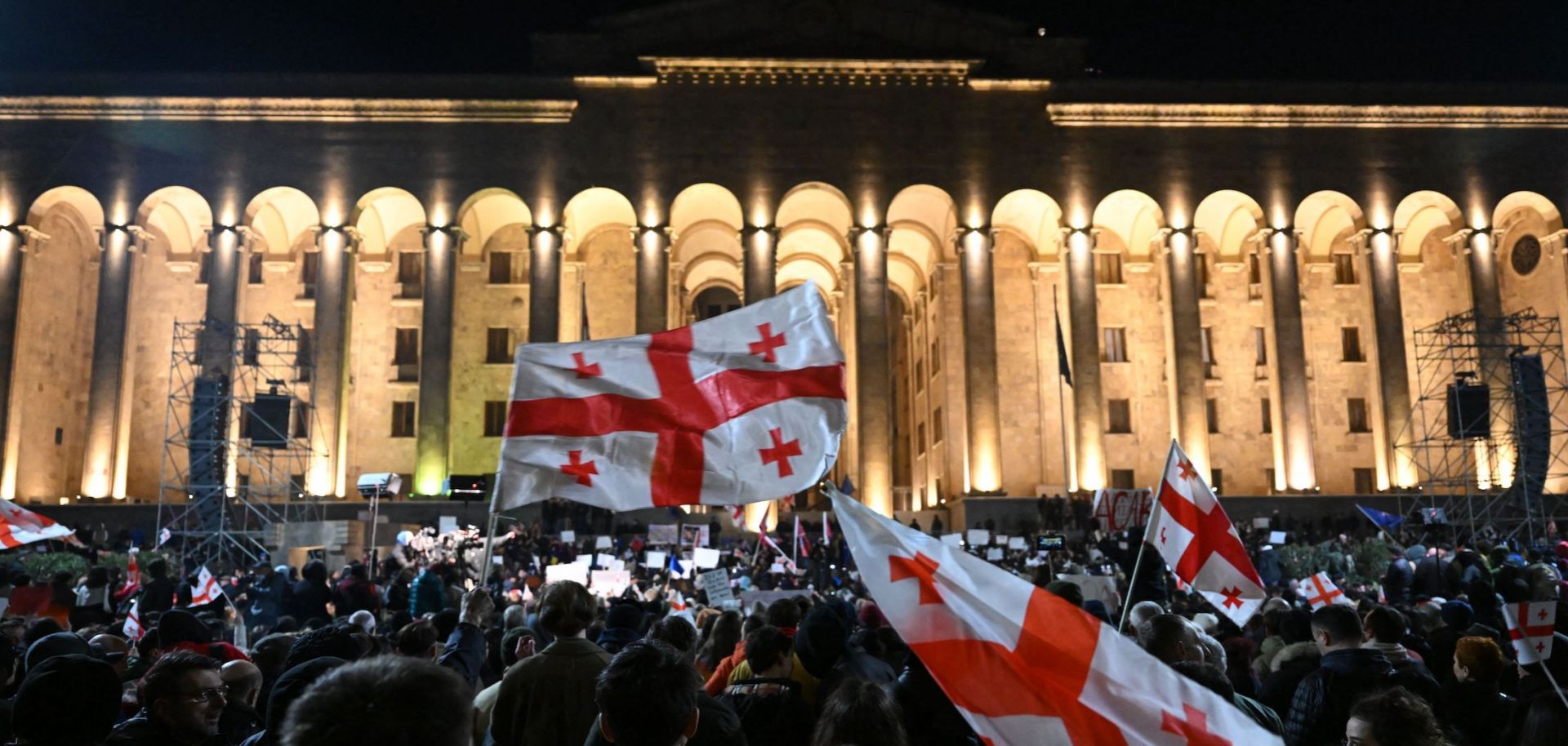
Georgian opposition supporters gather outside the parliament in Tbilisi on March 9, 2023, ahead of a vote on the ruling party's controversial ''foreign agent'' bill.
In Georgia, the rejection of a controversial bill will decrease the intensity of recent protests, but unresolved questions about the country's strategic trajectory could undermine its path toward greater Western integration. On March 10, Georgian lawmakers formally rejected a contentious ''foreign agents'' bill a day after the ruling Georgian Dream (GD) party announced it would withdraw the proposal. The bill would have required media outlets, nongovernmental organizations and other entities that receive 20% or more of their funding from abroad to register as ''foreign agents'' or be subject to heavy fines. The GD stressed that the bill had been unfairly disparaged by a ''machine of lies,'' which it said had falsely portrayed the bill as intending to mimic similar Russian laws, and left open the possibility of submitting a similar proposal in the future ''after emotions subside.'' The bill had drawn significant Western criticism and came after two nights of unrest in which protesters in the capital Tbilisi erected street barricades, burned vehicles and clashed with police officers, leading to the detention of dozens of people.
- The rejected bill was one of two being debated. The second, which is technically still under consideration despite a GD pledge to also remove it, would expand the scope of who is defined as a ''foreign agent'' to include individuals, who could be fined or sent to prison for up to five years for violating its terms.
- While the GD claimed the bills followed similar Western versions like the U.S. Foreign Agents Registration Act, critics accused the party of instead seeking to imitate Russia's well-known ''foreign agents'' laws that the Kremlin has used to severely crack down on dissent.
- Representatives from both the European Union and the United States, which had strongly condemned the bills, welcomed the Georgian government's reversal.
The debate over the legislation is the latest in a series of disputes over competing visions for Georgia's strategic alignment between Russia and the West. Since Georgia's independence from the Soviet Union in 1991, Russia has considered the country to be within its sphere of influence and sought to strongly exert its influence in Georgian politics to prevent it from moving toward the West. Russian troops still occupy two breakaway regions in the country following a brief war in 2008. The Kremlin is also widely seen as supportive of the ruling GD party, whose platform calls for a pragmatic relationship with Moscow and whose billionaire founder made his fortune in Russia in the 1990s. Nonetheless, opinion polls suggest that over three-quarters of the Georgian public support joining the European Union, a goal enshrined in the country's constitution. And Georgia (in concert with Ukraine and Moldova) formally applied for membership in the bloc days after Russia's invasion of Ukraine in February 2022. Even so, in June the European Commission backed candidate status for Ukraine and Moldova, but declined to do so for Georgia unless it met 12 conditions. In particular, the commission said Georgia had to make meaningful progress on reforming and improving the transparency of its judicial system, reducing political polarization by increasing cooperation with opposition parties, and pursuing ''de-oligarchization'' to eliminate corruption in all areas of society.
- In July 2021, GD withdrew from an EU-brokered and U.S.-supported power-sharing agreement it had signed with more pro-Western opposition parties earlier that year. The deal came after months of political turmoil following contested parliamentary elections in October 2020, which saw the GD win a third consecutive term amid allegations of vote buying and other electoral irregularities. The failed power-sharing agreement is indicative of the deep polarization that the European Union says is a major obstacle to the country receiving candidate status.
The bill's rejection will ease but not end protests, while the GD's failure to make necessary reforms will slow Georgia's prospects for greater Western integration. Lawmakers' dismissal of the ''foreign agents'' bill will lessen the severity of demonstrations in the coming days. Indeed, following the GD's announcement that it would withdraw the proposal, protests on the night of March 9 were already smaller and did not feature violence. But opposition leaders say they will continue rallying until the government also withdraws and rejects the second bill and releases those detained during protests. Some opposition members have even called for protests to continue until the government resigns, though this is a highly unlikely prospect. Moreover, the fact that the GD implied it could reintroduce similar legislation in the future and the popular perception that it is too pro-Russian mean that demonstrations could resurge should the government take further controversial steps. More broadly, while it has reversed course for now, the GD's decision to back the legislation in the first place despite clear objections from Brussels and Washington suggests it is not serious about its EU candidacy and other forms of Western integration. This — combined with the party's inability and/or unwillingness to implement meaningful institutional and political reforms over its nearly decade-long reign — will keep Georgia's EU candidacy out of reach for the foreseeable future and likely present future flashpoints that could catalyze mass protests.
- The recent episode also deepened a rift between the GD and President Salome Zurabishvili, who was elected in 2018 with support from the party but has since distanced herself from it. Though Salome's position is mostly ceremonial and the GD has the parliamentary support to override her veto, future disagreements between the president and the party could slow down the policymaking process.
- Former Georgian President Mikheil Sakashvili, who founded the opposition United National Movement party, has been in prison since October 2021 on what critics say are politically-motivated charges. His case has been a major irritant in relations between the GD-led government and Brussels.
- The European Union is expected to review Georgia's progress toward meeting its 12-point reform plan later this year but is widely expected to assess Tbilisi to have made little progress.
- Prior to the bill's rejection and withdrawal, the U.S. State Department spokesperson suggested that GD officials could face sanctions over the legislation.
