
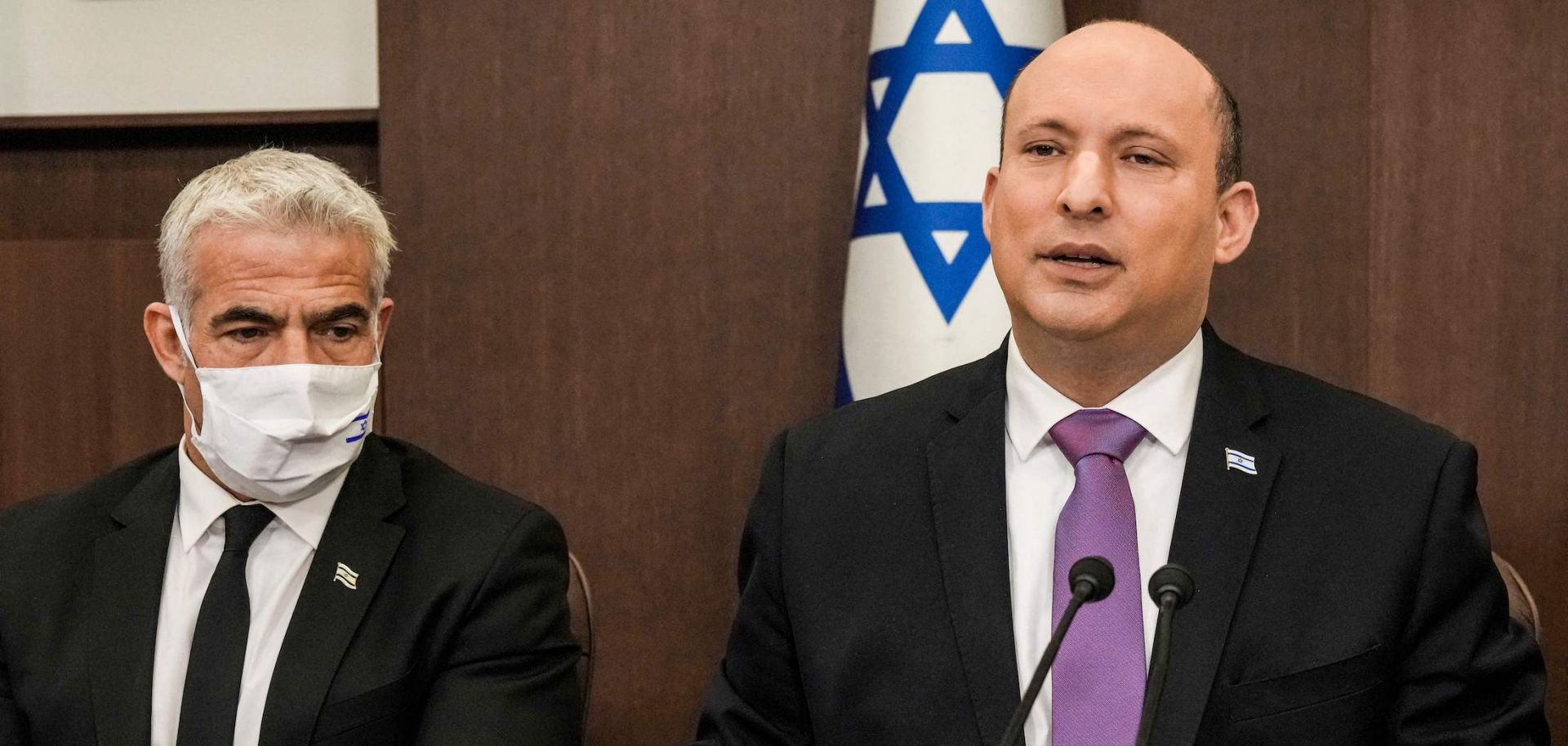
Israeli Prime Minister Naftali Bennett (R) and Foreign Minister Yair Lapid on Feb. 20, 2022, in Jerusalem.
Israel will attempt to remain neutral during the Ukraine war and offer diplomatic assistance to Russia and Ukraine in nonprovocative ways, positioning itself as a mediator to avoid Western pressure to impose sanctions on Moscow. This strategy may not, however, survive Russian escalation in Ukraine or Yair Lapid's anticipated assumption of the Israeli premiership in 2023. Over the last few weeks, Israeli Prime Minister Naftali Bennet has not condemned Russian aggression in Ukraine and has remained noncommittal when asked by President Volodymyr Zelensky to take a stronger stance against Moscow. Israel has also been deflecting pressure to block fleeing Russian oligarchs and their capital from entering Israel while also ignoring requests to provide Ukraine with more substantial military or intelligence aid. At the same time, Bennet has maintained continuous dialogue with Zelensky, providing humanitarian and medical aid to Ukraine. Israel's interest in neutrality in the Russo-Ukrainian war stems from its solid economic, religious, social, and military and security ties with both Ukraine and Russia.
- In 2019, a bilateral agreement between Israel and Russia was leaked in which Israel committed to refuse to sell weapons to Georgia and Ukraine in exchange for Russia refraining from selling arms to Iran. In 2010, Israel and Russia signed a five-year military agreement, and in 2015, Russia purchased IAI Searcher 3 drones from Israel.
- In 2008, Russia and Israel removed visa requirements for citizens traveling between the two countries. AP reported in 2018 that between 30 and 40 Russian oligarchs have dual citizenship in Israel, while thousands of more ordinary immigrants also hold passports to both countries. Similarly, in the last decade, Israel's tourism industry has seen a rapid increase in Russian travelers who find it easy to vacation in Israel given the number of Russian-speaking people in the country.
- When COVID-19 vaccinations started becoming available in 2021, Israel implemented strict policies for foreign nationals entering the country. In November 2021, Israel recognized the Sputnik V vaccine (which is not recognized by the World Health Organization, Food and Drug Administration, or European Medicines Agency) as an acceptable vaccination for entry. This move was unexpected given the Israeli government's strict standards regarding COVID-19 and record of only accepting internationally recognized vaccines.
- Israeli Foreign Minister Yair Lapid, who is set to become prime minister in 2023, has a more hard-line stance on Russian aggression than Bennet, having spoken with his international counterparts in countries like Romania and Slovakia on the need for Russia to resolve its unjustified actions through negotiations. Lapid has sympathized with the Ukrainian refugee crisis, stressing that it is Israel's "moral obligation" to help its displaced people.
- One of the fundamental bases for Ukrainian-Israeli ties is that Ukraine has been home to significant numbers of Jews for more than a millennium. Every year, members of the Hasidic movement, a subgroup within ultra-Orthodox Judaism, make pilgrimages to historic Ukrainian villages to pay respect to the gravesites of the founding rabbis of Hasidism ahead of the Jewish New Year. The governments of Israel and Ukraine have collaborated to ensure safe passage for families from Israel to Ukraine during such religious pilgrimages.
- Since the 1800s, approximately 1.5 million Russians (a term used in Israel to define immigrants from anywhere in the former Soviet Union) have immigrated to the modern state of Israel, and thus play an integral part in Israeli society. Fifteen percent of Israelis speak Russian. Avigdor Lieberman, a Russian-born immigrant from the former Soviet Union and leader of the Yisrael Beiteinu party, which holds seven seats in the government, receives most of its support from the country's large Russian immigrant population.
- According to Israel's Ministry of Economy and Industry, bilateral trade between Ukraine and Israel reached almost $800 million in 2020. Israel received about $650 million in imports from Ukraine and exported about $135 million in goods and services to Ukraine; 67% of imports from Ukraine were agricultural (grains, food products). Israeli services exports to Ukraine were around $65 million, while imports were around $78 million.
- December 2021 data on Russian and Israeli economic cooperation from the Observatory of Economic Complexity showed Russia exported $135 million to Israel and imported $122 million from Israel. Comparisons to 2020 exports showed a decrease in Russian exports to Israel of around 29% ($191 million to $135 million) and an increase in imports from Israel of about 9% ($112 million to $122 million). Israel exported services of $174 million and imported services of $145 million in 2021 to Russia.
Israel will pursue policies deliberately to avoid provoking Russia so it can remain a prime candidate to mediate between Russian President Vladimir Putin and Zelensky in discussions over cease-fires, civilian evacuations and other matters.
- To assist Ukraine while being mindful of its diplomatic relations with Russia, on March 1 Israel sent a 100-ton humanitarian aid package including medical equipment, water supply kits, blankets and winter tents. It also sent members of the United Hatzalah, Israel's volunteer emergency medical response service, to help the wounded on the ground and assist in evacuating Ukrainians from areas of fighting and to Israel.
- Around 25,000 Ukrainians have currently sought refuge in Israel, 5,000 of whom are non-Jewish and have received temporary visas.
- Yad Vashem, the Holocaust remembrance museum in Jerusalem, ended its "strategic partnership" with Russian oligarch and Putin confidant Roman Abramovich, a multimillion-dollar donor to the museum and other Jewish institutions in Israel. The action followed EU sanctions against Abramovich.
- Israel also decided to underwrite airlines flying to Russia, providing a $2 billion insurance guarantee as Western sanctions limit the ability of Russian airlines to secure financial security.
- Bennet on March 5 flew to Moscow to meet with Putin to discuss the escalating crisis, and subsequently met with German Chancellor Olaf Scholz in Germany and Zelensky via phone call for follow-up discussions. Most recently, Zelensky spoke to Knesset members on March 20, expressing the need for support and understanding for the Ukrainian people.
By presenting itself as a potential mediator, Israel seeks to delay its endorsement of Western sanctions and protect itself from Western pressure. The Israeli government will likely walk this line of nonprovocative assistance and support for both nations unless there is a significant escalation by Russia (such as the use of nuclear weapons, mass civilian killings, or occupation of Kyiv that could lead to secondary sanctions from the West on Israel), further pressuring Israel to participate in sanctions against Russia. Should Jerusalem accede to pressure from Western nations to implement sanctions on Russia, Israel will suffer economically, politically, socially and culturally. Jerusalem's credibility and diplomatic relations with Russia, which had been improving since Putin's election to office in 2000, will likely revert to pre-1991 levels, when Russia and Israel often cycled between being allies and adversaries.
A shift in power from Bennet to Lapid may make Israel more amenable to Western demands for a hard-line stance against Russia. While Bennet has maintained Israeli neutrality, this could end under Lapid given his relative outspokenness about the Russian invasion of Ukraine and greater sympathy for Zelensky's calls for support.
- Lapid has condemned Russian actions previously and vowed Russia cannot use Israel to bypass sanctions. After Zelensky's March 20 speech to the Knesset, he also commented that Israel would never turn its back on people who suffer from war.
- Given Lapid's more centrist ideology, strategic and personal interests combined could shift the Israeli narrative around the war. If Lapid breaks away from neutrality, he might participate in certain moves against Russia that allow him to align strategically with Israel's European and American partners.
