
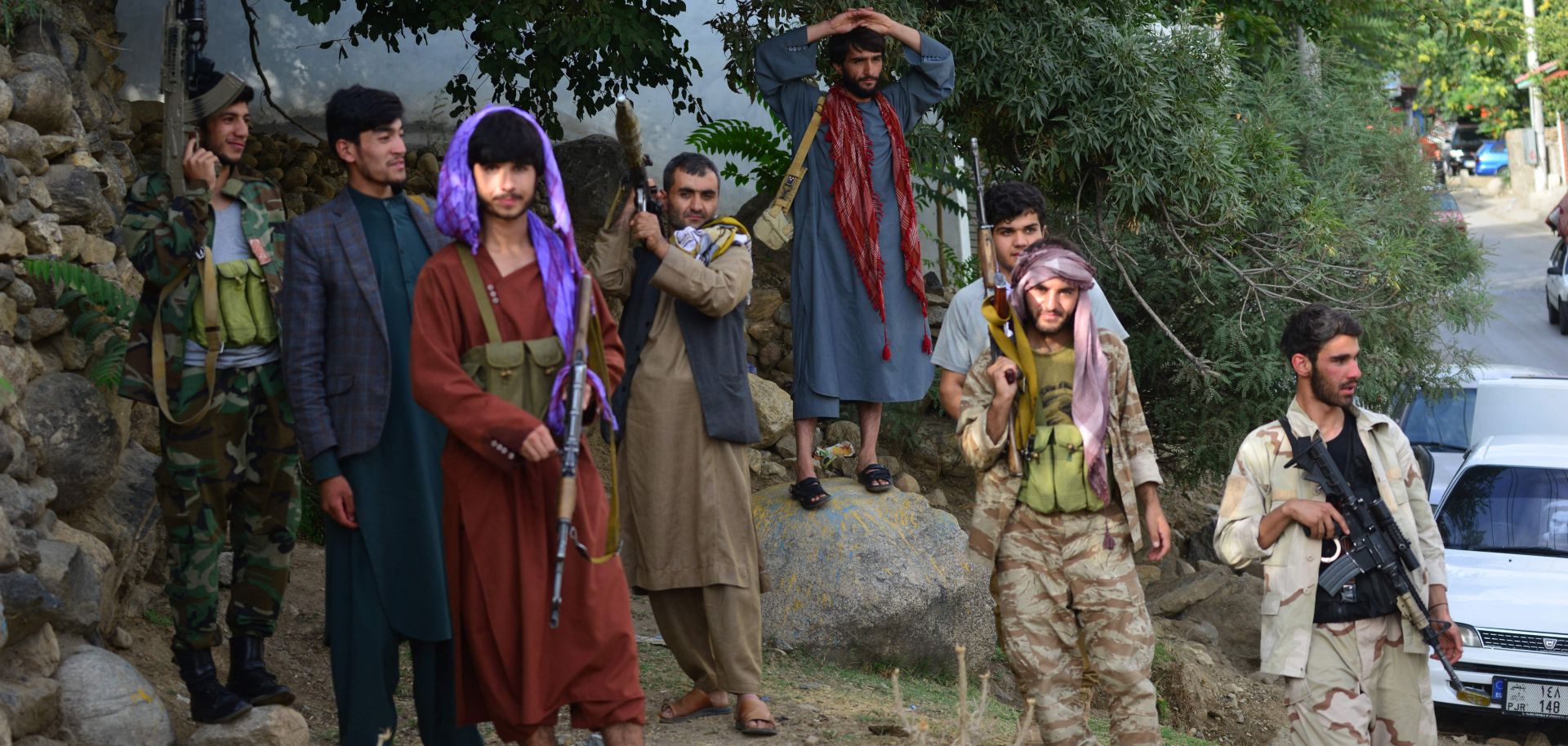
Armed men supporting Afghan security forces in the fight against the Taliban stand along a road in Panjshir on Aug. 18, 2021.
Several unconfirmed reports indicate former Afghan Vice President Amrullah Saleh and Ahmad Massoud, the son of the renowned Afghan resistance hero Ahmad Shah Massoud, are rallying anti-Taliban forces in the former Northern Alliance stronghold of the Panjshir Valley — bringing into question the Taliban’s ability to govern the entire country mere days after seizing Kabul. Saleh declared himself as the “caretaker president” of the legitimate government of Afghanistan on Aug. 15 after former President Ashraf Ghani fled the country in the wake of the Taliban’s capture of Kabul. The following day, photos emerged of Saleh meeting with Massoud in the Panjshir Valley, which has repeatedly proven difficult terrain to conquer and remains outside Taliban control. Some reports suggest Afghanistan’s former defense minister, Bismillah Khan Mohammadi, is also joining Saleh and Massoud, in addition to several other former Northern Alliance fighters and elements of the Afghan security forces. Saleh had close relations with Massoud’s father Ahmad Shah Massoud, who fought from the Panjshir Valley against the Soviet occupation from 1979-89, earning him the name “The Lion of the Panjshir. ” The elder Massoud also served in the Afghan government as defense minister beginning in 1992, before going on to co-lead Northern Alliance forces against Taliban rule. He was assassinated by al Qaeda days before the 9/11 attacks in 2001, in part to shore up support from the Taliban for the expected U.S. reprisal.
- Tajiks from the Afghan security forces have allegedly arrived in the Panjshir Valley as well with heavy equipment and vehicles, bolstering potential resistance forces.
- The Massoud family name widely resonates in Afghanistan, with the Sept. 9 anniversary of Ahmad Shah Massoud’s death commemorated annually.
While they remain unconfirmed, the reports of a budding anti-Taliban movement would fit a logical pattern in Afghanistan. Some members of the Afghan government and security forces have fled the country, and others have entered into negotiations with the Taliban. However, we would still expect to see others continue to resist Taliban rule through political and military means. The Taliban anticipated resistance, particularly from ethnic Tajiks (Tajik areas of Afghanistan remained largely outside of Taliban control in the 1990s). Taliban forces moved across northern areas of the country before swinging south to surround Kabul in order to disrupt the potential for organized opposition or the reconstitution of a Northern Alliance force. The Taliban reportedly left Jamaat Ansarullah, the so-called Tajik Taliban, in charge of the border with Tajikistan in an effort to split ethnic support for anti-Taliban operations (a tactic seen in many countries, most notably Myanmar, where the military has long pitted ethnic militia against their anti-government compatriots). This also potentially limits any Northern Alliance forces from resupply and recuperation in neighboring Tajikistan.
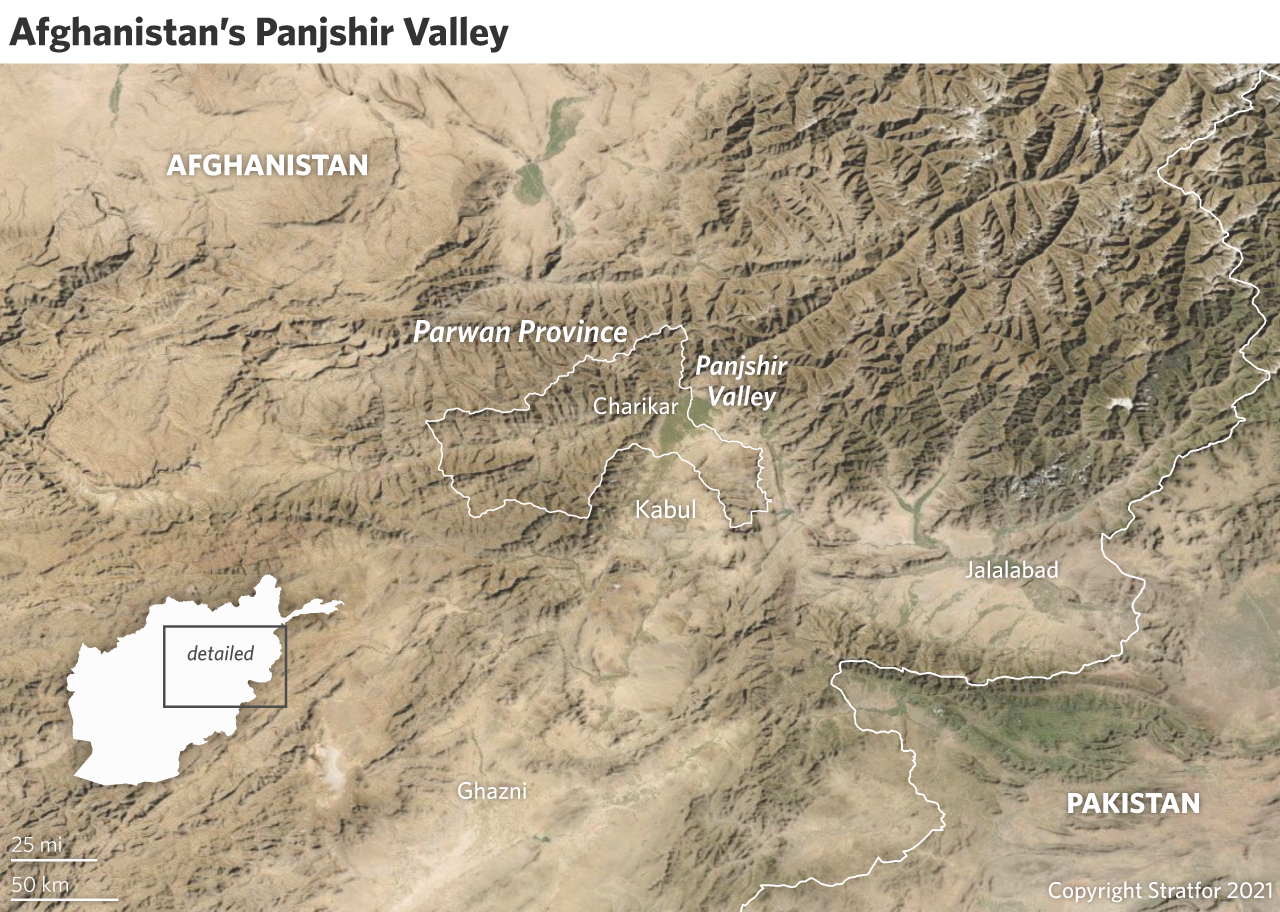
Taliban forces will continue to focus on the Panjshir Valley, even as they negotiate the final transition in Kabul. There are some reports that the younger Massoud may already be in discussions with the Taliban, which would counter reports of the formation of a new anti-Taliban militia. Massoud, in a recent interview with the Atlantic Council, had raised the potential for some accommodation with the Taliban, and perhaps a federalist structure for rule in Afghanistan. It is possible such ideas are part of the ongoing negotiations in Kabul and Oman regarding the next government of Afghanistan. While this would require some concessions from the Taliban, it would also reduce the likelihood of a continuing civil war, at least in the near term.
What to Watch For
As we monitor the situation, we have several outstanding questions we are addressing to determine the significance of opposition to the Taliban and the likelihood of expanded national conflict:
Is the reported resistance in the Panjshir Valley defensive or offensive?
- If the reports of a new resistance movement are true, it poses a significant challenge to the Taliban’s control and its search for international legitimacy. The Panjshir Valley provides a strong redoubt for a resistance movement, and while the Taliban claims to control all border crossings and most of the territory between the valley and the border, it is difficult to quell all movement of personnel and goods along the frontier.
- The resistance activity could also be more of a defensive operation, with the Panjshir Valley serving as a gathering place for those fleeing the Taliban or resisting Taliban control. There are reports, for example, of ethnic Hazara Shias moving into the valley to shelter from the Taliban. This would present a persistent problem for the Taliban, but not necessarily an unmanageable one, at least in the near term. While the Panjshir Valley is difficult terrain to conquer, the same strength of limited accessibility can be a liability, enabling the Taliban to largely bottle up the resistance within a single geographic area.
- If this is about building a base for future operations against the Taliban, then we are likely to first see anti-Taliban forces move to the north to open up the border with Tajikistan and establish lines of communication outside Afghanistan to ensure resupply and perhaps even personnel and training. It is possible that the Panjshir Valley first provides a defensive position before later becoming a base of operations for the counter-push against the Taliban, at least in the north. From the Taliban’s perspective, it is vital to deny the opposition, either defensively or offensively, the freedom to use the strategic and symbolic Panjshir Valley.
How coherent is this nascent resistance movement?
- One of the main challenges of the Afghan government and security forces has been the inability to overcome ethnic, tribal and political differences. The old Northern Alliance was able to coalesce around opposition to a single enemy and the new resistance may be able to do the same against the Taliban. However, it is not certain that all opposition leaders are equally committed to active resistance. Disagreements about an end goal would provide a space for the Taliban to exploit.
- At the same time, the Taliban, in losing their single enemy (the United States and other foreign forces) may face their own challenges of internal cohesion, providing opportunities for anti-Taliban forces to exploit. This could be further exacerbated if central Taliban leadership seeks to enforce their promise of not allowing Afghanistan to be used as a base to attack neighboring countries. This could, in turn, pit the Afghan Taliban against their allies in the south — namely, al Qaeda in the Indian Subcontinent (AQIS) and Tehrik-e-Taliban Pakistan (TTP) — shifting their focus away from the northern areas.
What level of external support is there for a militant resistance movement or an Afghan government in exile?
- While there is general international criticism of Taliban rule, there is also apparent exhaustion in fighting in the Afghan conflict. Overt foreign support for a resistance movement inside Afghanistan could keep foreign powers on a terrorist attack list, something that would be weighed against the perceived benefits of supporting another Afghan insurgency. Russia and China are both seeking stability in Afghanistan, and the United States is trying to refocus its attention to the Indo-Pacific. Other regional powers like India would also need to weigh the costs and benefits of active support, as would bordering states that would most likely see spillover.
Is active foreign support necessary in the early phases of resistance?
- If the new counter-Taliban movement has elements of the Afghan security forces, it also likely has access to sufficient arms and ammunition, at least in the near term. In addition, Afghanistan is notorious for being a haven for arms smuggling, providing another avenue for necessary supplies to move.
- The international community may block the Taliban from accessing Afghan monies abroad, but it is not assured that a government in exile or a resistance movement would be allowed access to those funds. Saleh’s recent move to declare himself as the leader of Afghanistan’s legitimate government may be an attempt to ensure access to those accounts.
