
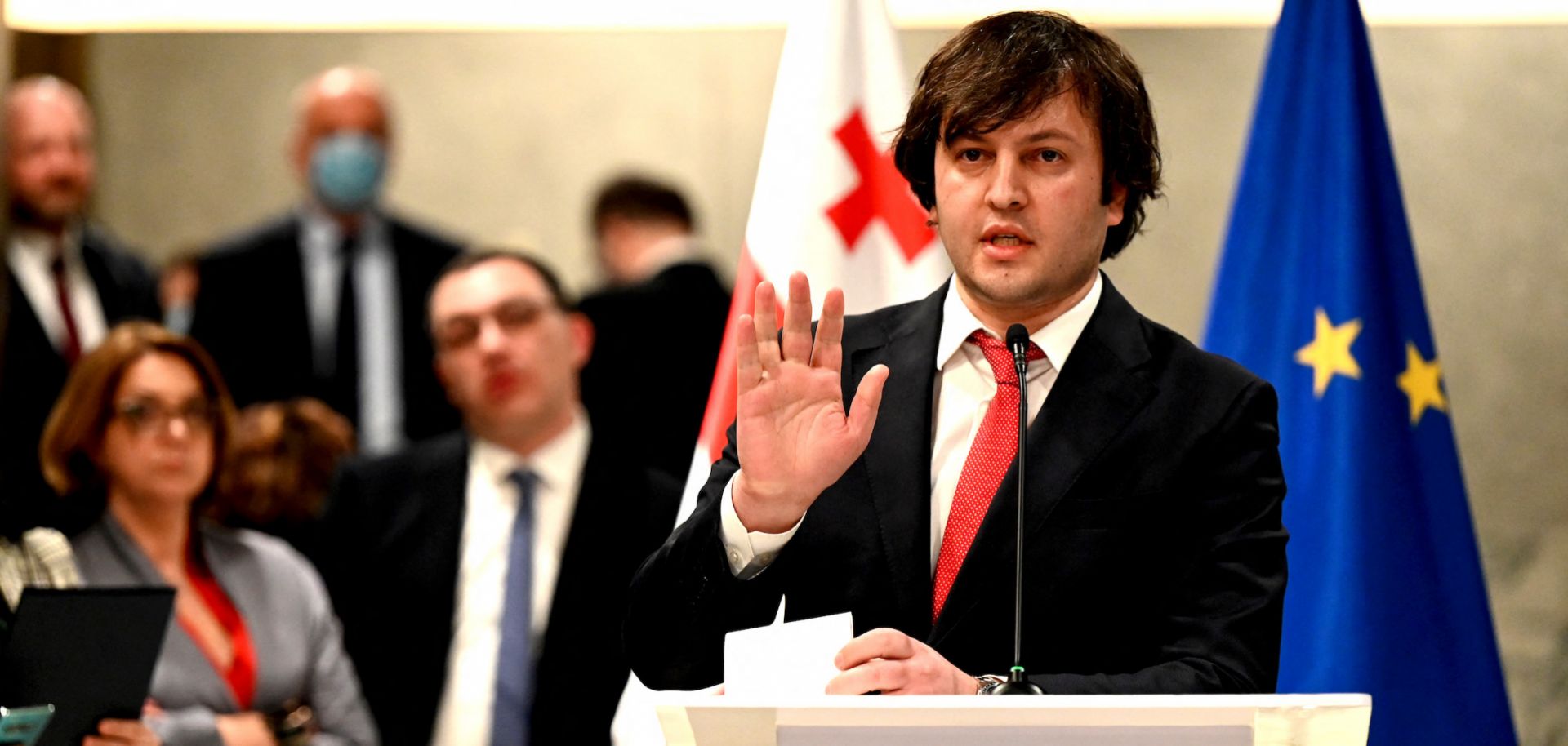
The chairman of Georgia’s ruling Georgian Dream party, Irakli Kobakhidze, attends a press conference following EU-mediated talks with opposition leaders in Tbilisi on March 31, 2021.
The dissolution of Georgia’s power-sharing agreement threatens the legitimacy of upcoming October elections and could result in the loss of Western economic support. On July 28, Georgia’s ruling Georgian Dream party announced it would withdraw from the EU-brokered and U.S.-backed power-sharing agreement it signed with opposition leaders on April 19. That agreement came after several months of political turmoil in the wake of Georgia’s contested October 2020 election, which triggered massive opposition protests. Widespread distrust of the ruling party’s administration of elections and last year’s parliamentary ballot, in particular, will persist during October’s local elections and potential snap parliamentary elections in early 2022, as only elections conducted concurrently with a functioning power-sharing between Georgian Dream and the opposition will have any chance at sufficient acceptance. On Aug. 2, Georgian Dream members of parliament repeated that the party had no plans to rejoin the EU-mediated agreement.
- The power-sharing agreement allowed parliament to finally convene and function for the first time since last fall, but electoral and judicial reforms in the agreement to address opposition grievances were not realized.
- According to the agreement, Georgian Dream consented to hold a snap parliamentary election in the spring of 2022 if it fails to garner at least 43% of the vote in October 2021’s local elections.
- Announcing the sudden decision, Georgian Dream Chairman Irakli Kobakhidze told reporters the agreement “served its mission and exhausted itself” 100 days after signing, noting that the majority of opposition lawmakers had refrained from joining the deal.
- The opposition asserts that Georgian Dream’s willingness to work with them rests on the precondition that the opposition will be permanently relegated to the status of junior partner by rigging elections against them.
Georgia remains unlikely to pursue further rapprochement with Russia, despite the opposition’s alarmist rhetoric that the country’s democratic future and pro-Western geopolitical course once again hang in balance following the ruling party’s withdrawal from the deal. Georgian Dream’s softening toward Moscow on the fringes of government policy over the years did not stop Georgia from continuing to assert its European aspirations. And there is little evidence this will change, even if domestic turmoil returns in the coming months. Indeed, amid the political crisis at home, Georgia recently inked an agreement with Moldova and Ukraine to form the “Association Trio,” whereby the three countries will meet regularly to support each other’s Euro-Atlantic integration aspirations and potentially even compete amongst themselves to achieve reform benchmarks the fastest.
- Opposition lawmakers in Georgia have attempted to tie the country’s faltering democratic development to an impending geopolitical shift back toward Russia. Prominent opposition politician Salome Samadashvili said that the annulment of the April 19 power-sharing agreement “officially confirmed that Georgia’s foreign policy orientation has changed.” Samadashvili also compared Georgian Dream’s move to former Ukrainian President Victor Yanukovych’s sudden rejection of the Associated Agreement with the European Union in 2013, which precipitated the Euromaidan revolution. Another opposition member of parliament said that by withdrawing from the April deal, Georgian Dream was refusing “the country’s Euro-Atlantic future” and warned that “this is how dictatorship takes hold, slowly and arrogantly.”
- Since coming into power in 2012, Georgian Dream has continued to pursue the goal of Euro-Atlantic integration. But the ruling party has also softened its stance on Russia and immediately pleased Moscow by going after Georgia’s former president Mikheil Saakashvili and his associates. Democracy advocates in Georgia have since raised alarms about the country’s democratic backsliding and state capture by Georgian Dream founder and patron Bidzina Ivanishvili, whose personal wealth of $6 billion is equivalent to roughly one-third of the country’s GDP.
Should the political standoff continue, Western economic support for Georgia will increasingly be at risk. Georgian Dream’s withdrawal from the agreement was seen as yet another example of the party’s proto-authoritarian tendencies, which the West has been objecting to for years as preventing the country from fully leaving Moscow’s orbit. A bipartisan group of U.S. Senators called the ruling party’s decision to “unilaterally walk away” from the deal “disappointing,” adding that the developments undermine the efforts toward the multi-party rule envisaged by the agreement, such as critical judicial and electoral reforms. European Council President Charles Michel said he had “equally” taken note of both the governing party’s withdrawal, as well as the largest opposition party (the United National Movement)’s refusal to sign the agreement, and said he would start consultations aimed at saving the power-sharing pact.
- Total U.S. financial assistance for Georgia has trended downward since Georgian Dream took power in 2012. Last year, the U.S. Congress moved to stipulate for 2021 that 15% of foreign aid to Georgia can be withheld if the U.S. Secretary of State determines that the Georgian government is not taking sufficient steps to strengthen democratic institutions and fight corruption — a clear signal to Georgian Dream that failure to move forward with reforms can have economic consequences.
- On July 13, U.S. State Department spokesman Ned Price left open the possibility of the United States sanctioning Georgian Dream officials responsible for recent violence at an LGBTQ pride event on July 5, and noted that he was aware of discussions around such sanctions in Congress.
- Western officials most recently raised the possibility of taking the unprecedented step of sanctioning Georgia in February following the arrest of opposition leader Nika Melia of the United National Movement. The step was ultimately rejected after experts suggested it would only deepen the crisis and serve Russia’s interests. Melia was ultimately freed as part of the agreement and is now running to be mayor of Georgia’s capital city of Tbilisi.
