

Editor's Note: Organized criminal activity is endemic to much of the world. Whether in the form of drug trafficking, fraudulent activity or scams, no market is immune from the threat. And wherever there is organized criminal activity, there are illicit funds making their way into the financial system. While banks and financial institutions have borne the brunt of penalties related to money laundering activities, criminals use a variety of legitimate business activities to conceal the source and destination of illicit funds. Understanding how money laundering works and popular tactics can help legitimate business operations avoid becoming vehicles for the laundering of criminal proceeds. In the first of this two-part series, we will review the basics of money laundering operations. We will then examine recent case studies and consider the future of the problem in part two.
Both legitimate and illegitimate business activities generate revenue distributed to employees, organizational leaders, investors and outside vendors that provide essential services. Any legitimate business owner will be familiar with the collection and distribution of funds through standard commercial bank accounts and investment vehicles. Criminal organizations have the same concerns, but for them, the process of collecting and distributing revenue is fraught with legal challenges. In most countries, a drug cartel cannot simply open a bank account under its own name, deposit proceeds from cocaine sales, and redistribute the funds to various leaders, employees and vendors. Not only would the bank report such obvious criminal activity, but the official transaction records left behind would allow investigators to identify and arrest the entire criminal network. Instead, criminal groups have to rely on obfuscation to manage their financial resources and move them around. As evidenced by numerous investigations and penalties levied against major international banks in recent years, many criminal organizations use the same financial institutions as legitimate businesses when it comes to managing their money. With increased scrutiny on illicit financial activities, criminal groups have had to rely on more sophisticated money laundering operations to evade detection.
The share of the global economy that is laundered is significant. The U.N. Office on Drugs and Crime estimates that criminal groups launder the equivalent of somewhere between $800 billion and $2 trillion in illicit funds per year. That is the equivalent of 2-5% of global gross domestic product. But money laundering is not just a tool for criminal organizations seeking to conceal the source of their illicit funds: Groups or individuals engaged in legitimate business activity may launder their revenue in order to evade taxes. States can also engage in money laundering, whether North Korea seeking to repatriate funds from financially motivated cyberattacks or Iran seeking to evade U.S.-led sanctions on its economy.
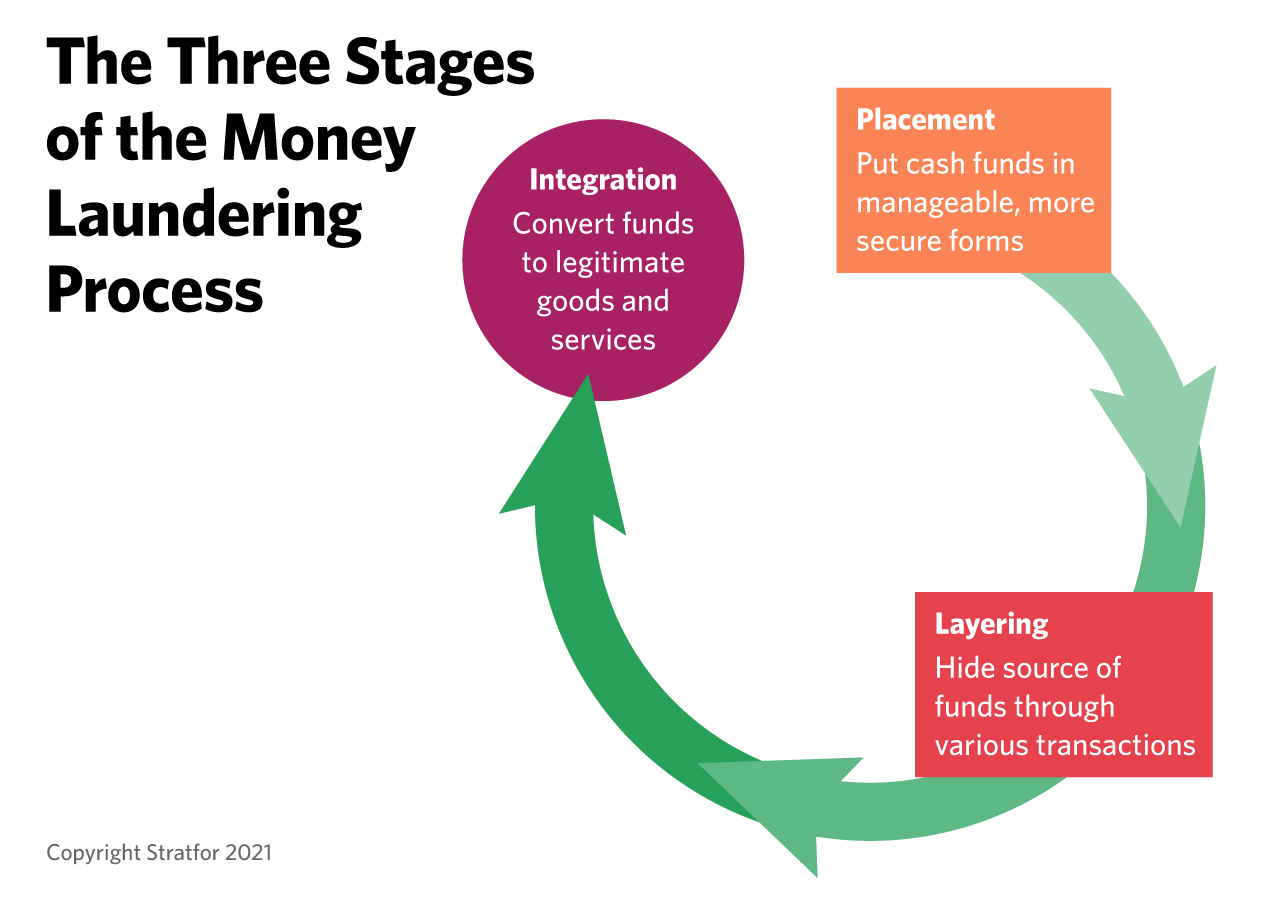
The Three Stages of the Money Laundering Process
Money laundering can come in a variety of shapes and forms, but there are generally three phases of the process:
- Placement is the deposit of illicit assets (typically cash) into a financial network where the funds can be more easily stored and transferred. While some money laundering schemes skip the placement stage and simply keep the assets in cash, storing and moving large amounts of cash presents multiple liabilities to criminal actors. Large amounts of cash can be stolen, destroyed or, if discovered by law enforcement, used as evidence against the criminal actors. Just as it is impractical for legitimate business operations to store their revenue in cash, criminal organizations also seek to store their revenue in easier to manage, more secure, bank accounts, financial instruments or other assets like real estate, precious metals or fine art.
- Layering is the process of obscuring the source of the funds and where the funds ultimately end up. It can be as crude as making multiple transfers from various accounts to more sophisticated money laundering schemes that convert the funds into various instruments, from cash to physical assets and back to cash, for example. This process is meant to prevent investigators from being able to connect the illicit activity to its financial benefactors, or at least to raise enough confusion so as to avoid legal liability.
- Integration is the final step that converts the illicit funds into legitimate goods and services. Once the origin of the funds has been sufficiently concealed, the receiver can use them to purchase properties or luxury items or invest them in financial products indistinguishable from goods and services purchased with legally earned funds. Prosecutions linked to money laundering typically involve the forfeiture of such goods and services.
Tactics
To achieve these steps, money laundering schemes rely on a variety of tactics. Although criminal networks are constantly developing new ones, the five highlighted below represent some of the most commonly used tactics. While not every money laundering scheme progresses cleanly through the three steps outlined above — for instance, some achieve integration in a single step, while others focus on concealing funds in the placement phase — they broadly adhere to the placement-layering-integration model:
- Illicit Currency Exchanges are unregistered, black market money exchanges that are integral in the placement and layering phases of the money laundering process. These money exchanges can convert illicit funds into foreign currencies and use informal networks to move funds to foreign countries where anti-money laundering regulations are laxer. At a minimum, these exchanges can move dirty money outside of the jurisdiction where the original crime was committed. Doing so can complicate investigations by typically requiring foreign assistance that is often difficult to coordinate even among allies with robust law enforcement capabilities, let alone rival countries that lack the political desire to cooperate.
- Structuring/Smurfing is also a tactic predominantly associated with the placement step of a money laundering scheme. Most countries have limits on cash deposits and when individuals exceed those limits, financial institutions are required to file a Suspicious Action Report, which can lead to further investigation. In the United States, that amount is $10,000. Money laundering schemes that involve illicit funds in excess of $10,000 often try to get around the limit by breaking up (or "smurfing," named after the miniature cartoon characters) the total into smaller amounts below the $10,000 limit. Less sophisticated schemes will involve the same person making deposits of $9,999 into the same account over consecutive days, while more sophisticated schemes will break up the amount into various sizes distributed across various accounts associated with various identities at various financial institutions over a broad geographic area.
- Front Companies/Fraudulent Invoices allow money launderers to complete the placement and layering steps of the money laundering process simultaneously by disguising illicit funds as legitimate funds. The fraudulent invoice tactic is typically used in conjunction with a front company that can record thousands or millions of dollars in sales for legitimate products when the revenue is actually coming from illicit activities. Unsophisticated front companies that use fraudulent invoices are fairly easy to detect through basic auditing or due diligence practices, as they can lose significant amounts of money in the business they claim to be operating in. The bar, restaurant and hospitality sector is popular for local money laundering operations due to high cash turnover. Given the risks associated with money laundering, criminal organizations are typically willing to accept some loss in order to secure their illicit revenue, but they will have an upper limit to their loss tolerance. More sophisticated front companies, for example, in the import/export or construction businesses, can turn into legitimate revenue-generating operations in their own right, allowing criminal actors to operate in the illicit and legitimate economies.
- Shell Companies/Offshore Accounts allow individuals to separate their identity from their assets to avoid legal scrutiny during the integration step of the money laundering process by using special legal instruments and establishing financial channels to foreign jurisdictions. The 2016 leak of over 11 million documents known as the Panama Papers outlined how unscrupulous wealth management companies helped wealthy individuals and organizations avoid legal and financial obligations in their home country by putting accounts under different names and changing other key details to distance individuals from their wealth while still maintaining control over it. Such tactics are used both by individuals who earned their wealth legitimately but seek to decrease tax burdens or political pressure and individuals who obtained their wealth illegally and seek to secure it.
- Trade-Based Money Laundering is a strategy that involves the placement, layering and integration steps of the money laundering process. It is especially attractive to foreign-based criminal organizations seeking to repatriate their money from the markets where they earn it — most notably, the United States. In this scheme, criminal organizations use illicit revenue to purchase durable goods such as cars, refrigerators, washing machines, etc. (placement) and export them to their home country. They then sell the items on the local market (layering) and collect the converted revenue, which has the appearance of coming from a legitimate import operation and therefore distracts from the integration phase of the process. This scheme is especially attractive because it can offer criminal organizations a way to earn money off their illicit funds by selling the legitimate products at a markup.
Next: Recent case studies, and the future of the problem.
