
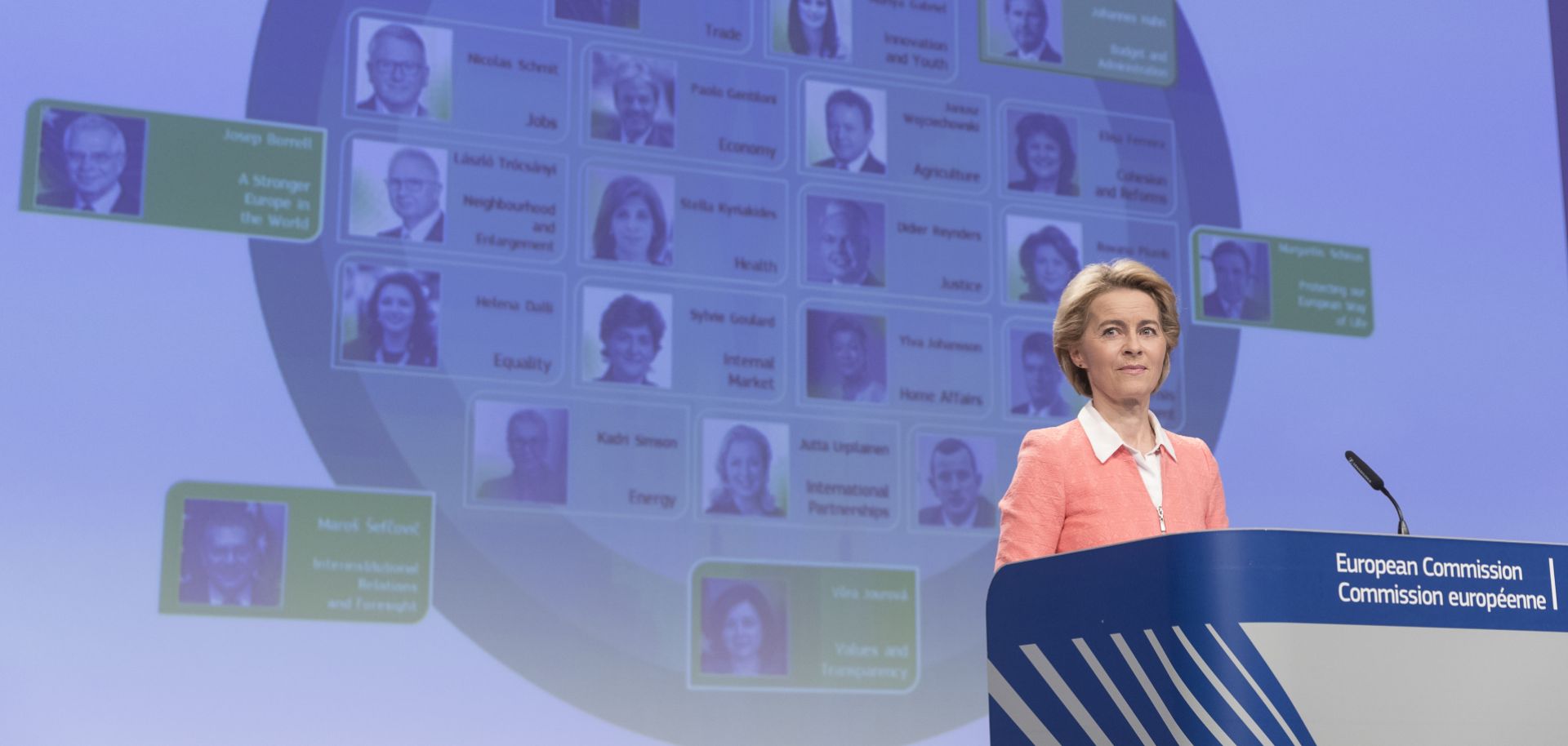
The European Commission's president-elect, Ursula von der Leyen, unveils her new team during a Sept. 10 press conference in Brussels. Under von der Leyen's leadership, the commissioners will reflect the bloc's policy priorities and ambitions for the next five years.
A new European Commission led by President Ursula von der Leyen is slated to take over in December after the European Parliament approves her team later this month. In preparation for her new post, von der Leyen has outlined a bold "geopolitical" vision that focuses on defending the European Union's interests amid growing competition among global powers like the United States and China. This entails a tougher implementation of antitrust rules and increased pressure on other countries to open up their markets to European investment, as well as new environmental standards and attempts to fix the bloc's broken immigration system.
But whether the president-elect's commissioners will actually manage to follow through on her big plans once they take office next month will prove a far different story, as they'll be forced to work within the confines of the continent's increasingly divisive political climate and gloomy economic forecast.
Competition and Tax Policies
There will largely be continuity in this area, as Margrethe Vestager will keep her position as competition commissioner in an expanded role that also includes the digital economy. During her first term, Vestager approved fines against technology giants such as Apple, Google and Facebook, as well as some European carmakers, for anti-competitive practices. She also opposed state aid for companies and mergers between large firms. Earlier this year, for example, she notably opposed a merger between Germany's Siemens and France's Alstom. But at a recent European Parliament hearing, Vestager also said she opposed splitting large companies into smaller units to prevent the formation of monopolies, describing it as a "last resort." Instead, she said she would focus on tools such as fines and regulations to solve competition issues within the European Union's single market.
But there are signs that Vestager will ramp up her more hawkish approach by using all the tools at her disposal (and proposing new ones) to enforce antitrust legislation. In mid-October, the commission ordered American chipmaker Broadcom to stop enforcing contractual provisions that prevented its clients from buying chips from other suppliers. In an unusual preemptive move, the commission issued the order before the completion of an antitrust investigation into Broadcom. More preemptive moves could expose major tech giants operating in Europe to more punitive measures, even before authorities complete probes. Since such companies predominantly hail from the United States, this behavior risks inflaming Brussels' relations with Washington. Indeed, the commission is already conducting an antitrust investigation into Amazon's use of client data and is also considering a new investigation into Facebook's proposed digital currency, Libra.
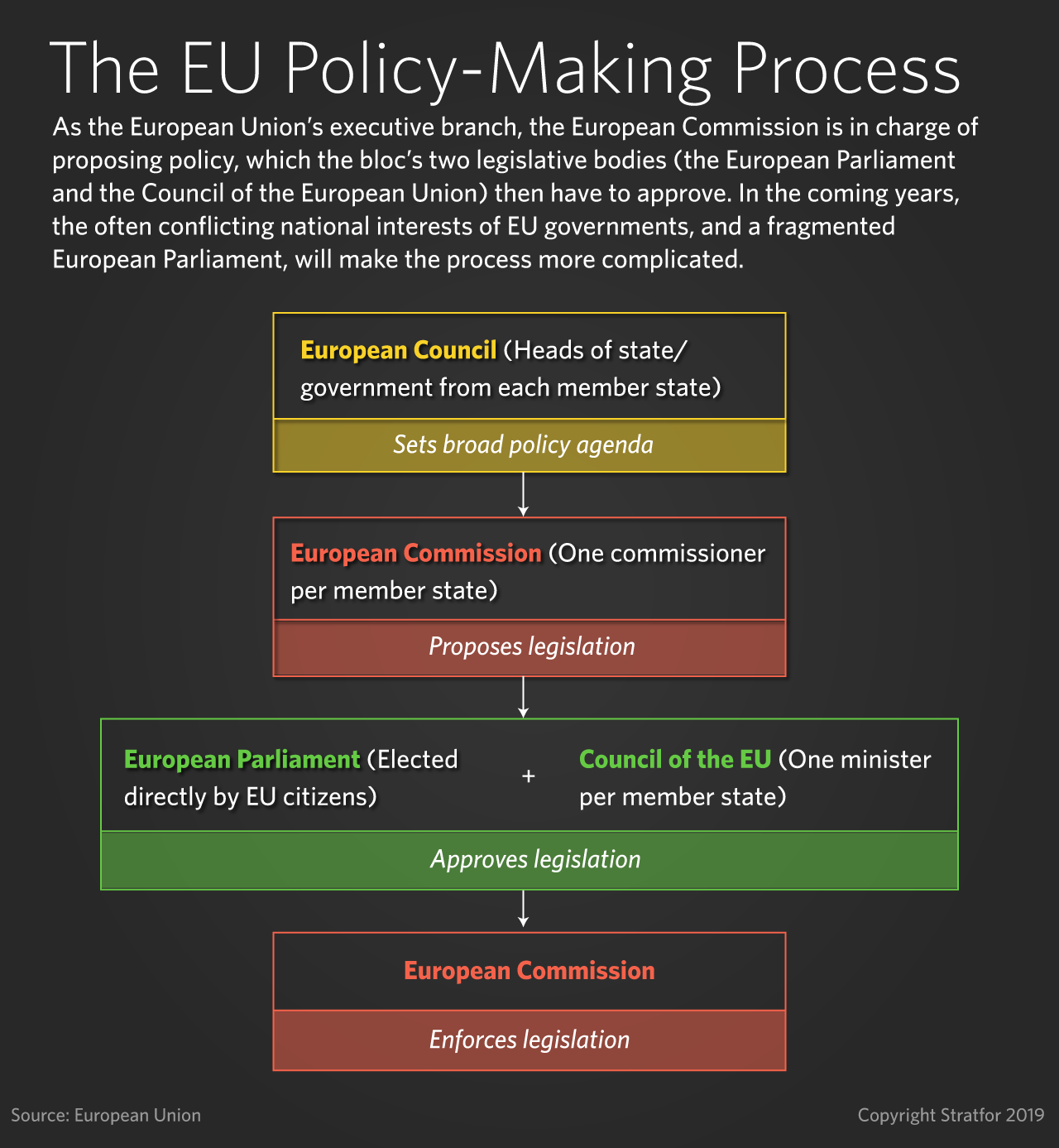
Germany and France, meanwhile, will defend their own vision about the future of EU competition policy. After the blocking of the Siemens-Alstom merger, Paris and Berlin presented a plan to help European companies better compete against their rivals from the United States and China. The plan proposes making it easier for large European companies to merge and create "industrial champions" that can compete with their American or Chinese counterparts. The Franco-German vision also proposes increasing state aid and subsidies for companies in strategic sectors and suggests that the bloc's national governments should have the power to overrule commission decisions on competition issues. But while Paris and Berlin will insist on their proposals, smaller EU countries will likely oppose the plan and instead stick with the commission's approach out of fears that the new policies would mostly benefit only large French and German companies and damage smaller companies from the rest of the continent.
The new commission will try to make companies in the digital sector pay higher taxes. The Organization for Economic Cooperation and Development (OECD), a club of developed countries, is currently trying to reach an agreement on how to tax large digital multinationals, but progress has been slow. Von der Leyen has said that if the OECD fails to agree on a common digital tax by the end of 2020, she will push to pass an EU version. But her chances of success are low because tax issues are decided by unanimity in the EU, which means that countries that currently offer low taxes to digital companies (such as Ireland or Luxembourg) have veto power. These same countries will also be willing (and able) to thwart von der Leyen's other proposals to eliminate differences in tax rules among EU countries and introduce a common consolidated corporate tax base in the bloc.
Trade and Investment Policies
Phil Hogan, a former agriculture commissioner, will serve as the European Union's new trade commissioner. Thus, while the new European Commission will seek to finalize the free trade agreements that they are currently negotiating with countries such as Australia and New Zealand, it will likely remain reluctant to open its internal market to foreign competitors — especially when it comes to agricultural products.
This will have important implications for the European Union's ongoing trade negotiations with the United States. The commission will seek to keep the conversations with Washington alive, though progress toward finalizing an actual deal will probably remain slow due to disagreements, especially over whether it should include agricultural products. The new commission will also have to deal with constant U.S. threats to introduce higher tariffs on European products such as vehicles. In this, Brussels will likely remain a reactive player, imposing counter-measures only in response to moves by the White House in order to keep tensions from escalating.
The European Union's proposed trade agreement with the South American trade bloc Mercosur, meanwhile, may never come into force. On the EU side, countries such as Ireland and France have continued to push back against the deal for fear of opening their vulnerable agricultural sectors to South American competition. But the agreement will soon face more resistance on the Mercosur side as well, once Argentina's new protectionist government takes office in December.
In addition, the new commission will take a more aggressive stance against foreign countries that apply discriminatory policies against Europe. Von der Leyen's team has shown an interest in resurrecting an old plan that would restrict foreign companies' access to the EU market if they're based in countries with perceived discriminatory policies against European firms, such as China. Von der Leyen has also pledged to make more extensive use of recently approved rules to increase the EU oversight of foreign companies acquiring businesses in strategic sectors in Europe, such as infrastructure (energy, transportation, communications) and technology (robotics, artificial intelligence). Large countries like France and Germany are likely to support this enhanced oversight as they seek to protect their domestic companies from foreign competition. But smaller, more cash-strapped countries in Southern and Eastern Europe will resist plans that could stem the flow of much-needed foreign direct investment.
Environmental Policies
The commission will pressure European companies to enforce increasingly ambitious environmental standards as part of its European Green Deal. The proposals laid out in the plan — which von der Leyen has promised to introduce in her first 100 days in office — include enshrining the climate neutrality target for 2050 into law; expanding the Emissions Trading System (which limits the amount of greenhouse gases industries can emit) beyond just the bloc's industrial sector to the maritime and construction sectors; and creating a Carbon Border Tax for products based on their carbon footprint.
Foreign firms operating in the bloc should thus prepare for greater regulatory pressure to reduce their carbon emissions. Most of these proposals, however, will require support from national EU governments, which will complicate their implementation. Applying the Carbon Border Tax will prove particularly difficult, as tax-related issues require unanimous approval by EU governments in the European Parliament — several of which oppose introducing any EU-level taxes that could raise prices for their consumers. Industrial lobbies, both in Europe and abroad, have also spoken against the plan.
Enlargement and Immigration Policies
The commission will struggle to repair the European Union's accession system, which serves as one of its main "soft power" tools. The European Union has traditionally used the promise of joining the bloc to influence policy decisions in its periphery. But in early October, Brussels decided not to start such accession talks with North Macedonia and Albania under pressure from a small group of countries led by France. Paris even went so far as to demand that the entire accession mechanism be revised to make it more political and less technical. This situation has since eroded Brussels' credibility when it comes to promising candidate states EU membership if they do what the bloc tells them.
The weakened promise of EU accession could grant an opening to the other regional and global powers currently vying for influence in the bloc's periphery, such as Russia, China and Turkey. It could also make governments in candidate countries slow the pace of economic and institutional reform and even return to authoritarian policies that they softened in recent years due to EU pressure. To insure against these risks, Brussels will find an ally in Croatia, which will take over the bloc's rotating presidency during the first half of 2020. The commission and the Croatian government will organize a summit between the European Union and Western Balkan countries in Zagreb in May, during which the bloc will reassure candidate countries in the region that the promise of EU accession is still alive.
Devising a comprehensive immigration strategy will also prove difficult for von der Leyen's team. The president-elect has promised to launch a New Pact on Migration and Asylum. Some of the plan's proposals — namely, strengthening the bloc's border control (the European Border and Coast Guard Agency), and increasing financial and logistical assistance for the countries of origin and transit of migrants — stand a strong chance of implementation. But the proposal to reform the bloc's so-called Dublin Regulation, in which migrants have to apply for asylum in the first country in which they enter the bloc, will prove a much harder sell. Mediterranean states such as Italy and Greece have argued the current asylum rule unfairly places the burden on them. But brewing nationalist sentiment, particularly in Central and Eastern Europe, means governments elsewhere will continue to resist any mechanisms that would distribute migrants across the bloc.
Fiscal Policies
The new European Commission will try to advance its ambitious policy agenda at a time of cooling economic growth in the eurozone. In an attempt to bring the bloc's expansion back up to speed, the European Central Bank (ECB) has called on EU member states, particularly those in the north, to increase public spending. Meanwhile, some EU governments (particularly in the south) have pushed to raise what they see as the European Union's stifling debt and deficit limits. Several of these countries have also proposed changing the ECB's main policy focus from inflation to growth or employment. Reaching a consensus on these sweeping economic reforms, however, will be a tall order at a time of such deep political fragmentation in the European Union. Instead, the commission will probably become more tolerant of countries keeping relatively high deficit levels, at least as long as economic growth remains low.
The Takeaway: Pipe Dreams or Plausible Policy?
Due to the European Union's deep political fragmentation, von der Leyen's ambitious policy agenda will face obstacles and setbacks in those areas where cooperation with individual member states and the European Parliament is required. This — combined with the bloc's slowing economic growth — will complicate Brussels' ability to implement any new legislation that involves particularly contentious issues, such as taxes and immigration. However, the president-elect's proposals will have a relatively high chance of success in the areas where Brussels can operate alone. This means the commission will be free to more avidly implement rules that already exist, such as competition and antitrust legislation, while success on other areas of its ambitious agenda will be more modest.
