
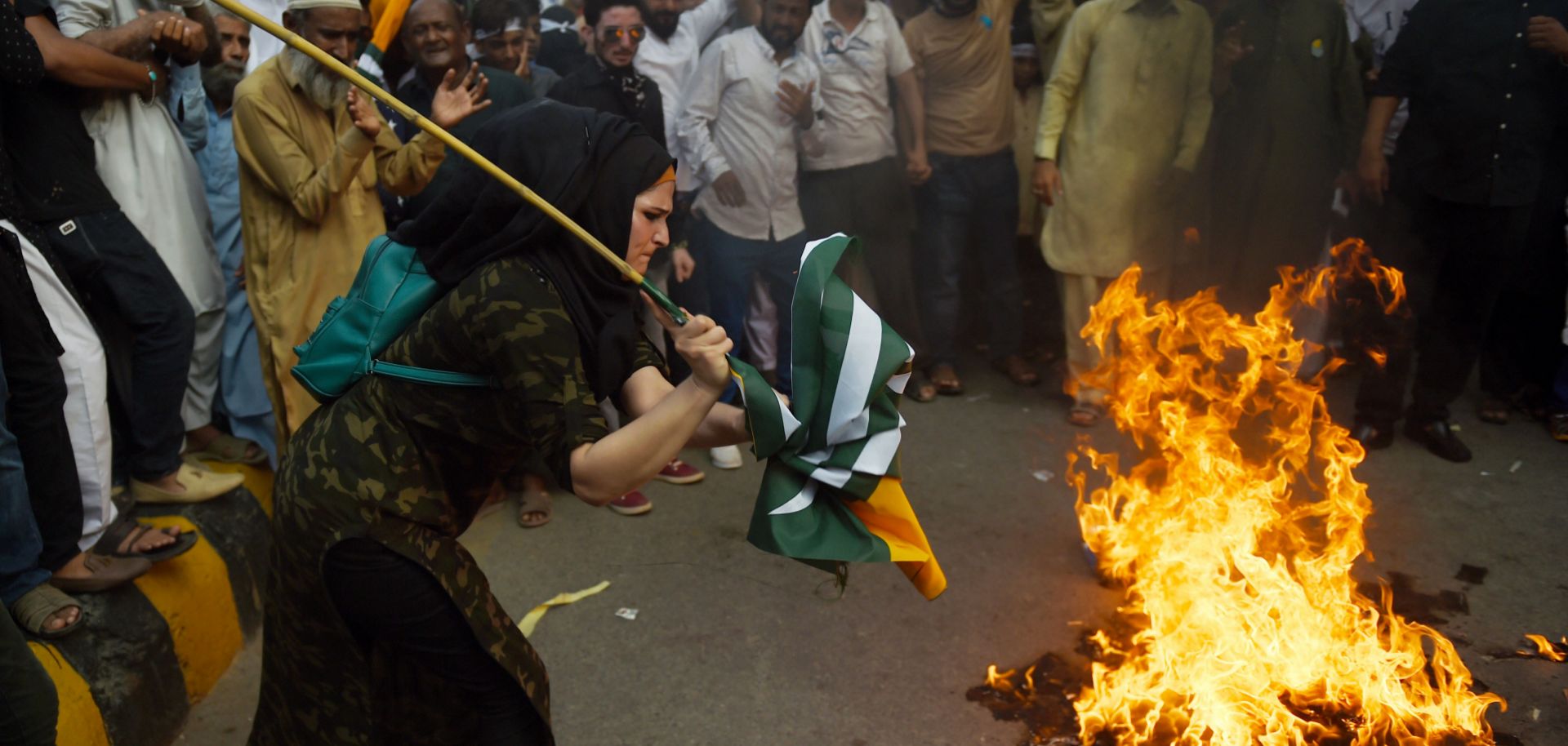
Jammu and Kashmir is in the midst of a seismic political shift after New Delhi announced it was stripping the state of its autonomy and splitting it into two centrally administered territories.
It's been almost a month since the government of Indian Prime Minister Narendra Modi stripped the disputed Himalayan region of Jammu and Kashmir of its nearly 70-year-old constitutional autonomy. The decision has since sparked both jubilation and outrage across India's diverse political spectrum, as well as weeks of protests in Kashmir. For the state's former chief minister, Mehbooba Mufti, the Aug. 5 announcement amounted to "the darkest day in Indian democracy." But to Modi's supporters, it advanced the long-cherished objective of absorbing the territory into the union.
Modi is keenly aware of the dangers his decision gives rise to, including risks of a more violent insurgency in the region and of worsened relations with Pakistan. But for the recently reelected prime minister and his ruling Bharatiya Janata Party (BJP), the benefits of advancing India's territorial unity outweigh the risks — especially amid shifting power dynamics in South Asia.
Laying the Groundwork in Kashmir
On Aug. 5, President Ram Nath Kovind issued a presidential decree overriding the Indian Constitution's Article 370, which enshrined Kashmir's autonomy. New Delhi then split the region into two centrally administered territories. To contain the inevitable backlash, Modi sent an additional 35,000 troops to the already-heavily militarized state, imposed a media blackout, cut off phone and internet access, and detained three former chief ministers just before the announcement hit Kashmir. The prime minister's precautions make clear his decision was a well-planned political maneuver.
Modi knew he would never earn the approval of the Kashmiri legislators needed to revoke Article 370. So he bypassed the state's political leadership, a tactic facilitated by his party's growing clout in the state's politics. In 2015, the BJP for the first time entered into a coalition with Kashmir's People's Democratic Party (PDP). But the two held opposing views: The BJP wanted to abolish Kashmir's autonomous status, while the PDP sought more autonomy. Tensions grew, and the alliance finally collapsed in June when the BJP withdrew from the coalition.
This paved the way for New Delhi to place Kashmir under "president's rule," in which the state's administration would now fall to its governor — a position conveniently appointed by the country's president. In August 2018, Kovind — a Modi appointee — replaced Kashmir's incumbent governor with a BJP member, Satya Pal Malik, who then dismissed the state assembly in November. With the assembly dissolved, Kovind now relied on Malik's consent to officially strip Kashmir of its self-governance — clearing the way for Modi to make his move.
Making Sense of Modi's Bold Move
Several external and internal factors propelled his decision to pull the trigger, including a looming development just northwest of India's borders. As the United States negotiates an exit from Afghanistan, Modi fears that a government in Kabul involving the Taliban could help Pakistan, the organization's primary sponsor, secure the contested western Pakistani flank with Afghanistan. If Islamabad can quiet Afghanistan's long-standing claims on Pakistan's northwestern tribal regions, there's a chance Pakistan could advance its own territorial unity and shift its security assets toward India. For Modi, maintaining the balance of power in South Asia thus requires Indian gains in Kashmir if Pakistan makes gains in Afghanistan.
But in addition to fending off threats to India's regional power, Modi had another motivation for absorbing Kashmir: demonstrating progress in the face of a cooling economy. Lagging rural demand, diminished public spending, and a shadow banking crisis have all hurt growth in the country's $2.6 trillion economy. In February, the Pakistan-backed militant group Jaish-e-Mohammed (JeM) claimed a major attack against security forces in Kashmir. Modi — who was running for reelection at the time — doubled down on his national security platform by launching airstrikes against Pakistan in the hopes of rousing his base before the vote. Modi's diversionary tactics received vindication from the BJP's landslide victory in May, which gave him a second term and his party an even bigger majority in parliament.
Autonomy and Unity: The Enduring Tension
But perhaps most important for Modi is the fact that Kashmir's deeply ingrained autonomy has long stood in the way of India's quest for national unity. In 1987, it's widely believed that the Indian National Congress party in power at the time rigged Kashmir's assembly elections. Congress did much to erode Kashmir's autonomy in the name of Indian unity, but the Hindu nationalist BJP's rise to power accelerated the process.
Absorbing the contested region figures prominently in the country's Hindu nationalist movement, which seeks to define India as a Hindu nation. And indeed, it was the BJP's skillful use of Hindu nationalism that propelled the party to dominance, giving Modi the political grounding needed to revoke Kashmir's autonomy in one fell swoop.
With Kashmir under his control, Modi will now seek to strengthen the BJP's presence in a state where the majority of its 12 million inhabitants are Muslim. To do so, Modi will likely encourage the migration of non-Kashmiri Hindus to the region. Success, however, will depend on first securing the region. This will not prove easy if the region's new status fuels the insurgency that began some three decades ago.
Fanning the Flames of Insurgency
The redistricting of Kashmir's 87-seat legislature will play a crucial role in how things play out. Kashmir, the Indian state's Muslim-majority region, currently holds 46 seats, while Hindu-majority Jammu holds 37. If the government allocates more seats to Jammu — and if Jammu experiences a faster population growth than the Kashmir region, as Modi's hopes — the balance of power in the state will shift and the Kashmir-based parties will weaken. But this could just as well make Kashmir's influential bloc of separatist parties all the stronger by bolstering their push for power. And it could embolden the militants behind the insurgency, including the Pakistan-backed JeM, Hizbul Mujahideen and Lashkar-e-Taiba.
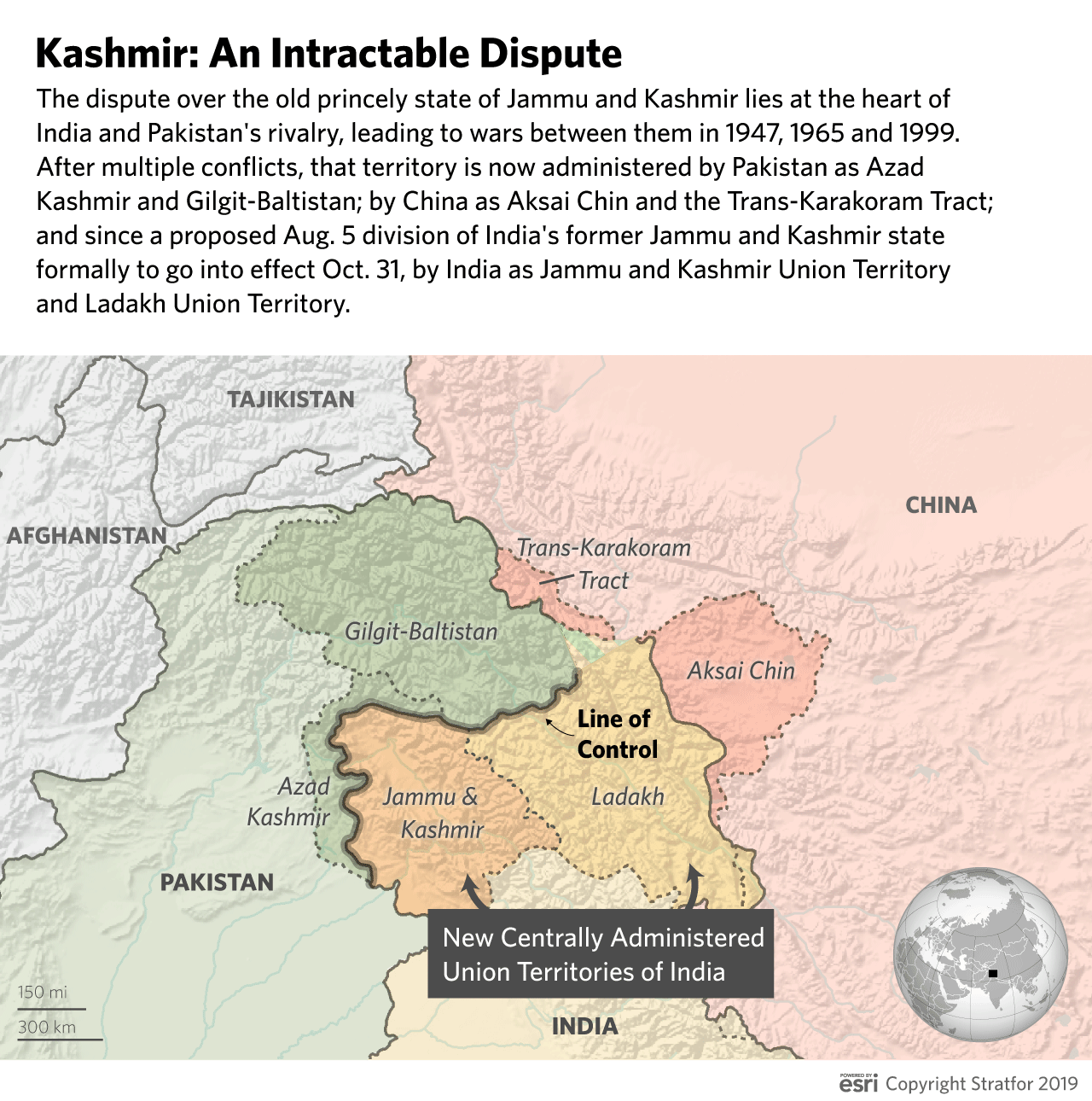
Such shifts in the 30-yearlong insurgency are the factor likeliest to lead to worse Indian-Pakistani relations. Pakistan — which has fought three wars with India for control of the former princely state of Kashmir — has already vehemently condemned Modi's decision, with Prime Minister Imran Khan vowing to uphold his nation's support for Kashmiri self-determination. And as cross-border airstrikes in February illustrate, just one militant attack can send tensions in the region spiraling. In fact, the situation in Kashmir is so delicate that the impact of a single militant death can be equally profound. When Indian security forces killed Hizbul Mujahideen commander Burhan Wani in 2016, monthslong protests erupted — prompting more locals to get involved in militancy.
If the Pakistan-backed insurgency in Kashmir keeps drawing in more locals, Pakistan's leverage over militants could weaken. But a high-casualty attack would likely result in an Indian retaliation against Pakistan no matter how much control Pakistan wielded over the attackers, bringing the nuclear archrivals closer to conflict.
Playing With Fire
China and the United States have more interests in Kashmir than any other foreign country, China because of its sovereignty over Aksai Chin — a territory India claims as part of Ladakh. Because Beijing is directly involved in the Kashmir dispute, India's decision to tighten its grasp over the territory may shape its territorial disputes with China, including in the Indian-administered territory of Arunachal Pradesh that Beijing also claims.
For the United States, Kashmir raises a different dilemma: Pakistan could react by using its leverage over the Taliban to delay a U.S. peace deal in Afghanistan. But New Delhi is also a key U.S. economic and defense partner, and has made it clear it wants to keep the United States out of its internal dispute with Islamabad. In an effort to appease both countries, U.S. President Donald Trump has offered to mediate the situation. But after a recent meeting with Modi at the G-7 Summit, Trump appeared to back off his offer.
That said, China and the United States are unlikely to directly intervene in Kashmir until an all-out battle between India and Pakistan commands their attention. Should the state's new status in India give way to even more insurgency in the region, such conflict becomes more likely.
